On the link below is a wonderful article that affirms my journey…written by a therapist.
http://ritualabuse.us/research/leaving-the-family-system-an-honorable-choice/
I highly recommend reading if you are a victim of child abuse.
On the link below is a wonderful article that affirms my journey…written by a therapist.
http://ritualabuse.us/research/leaving-the-family-system-an-honorable-choice/
I highly recommend reading if you are a victim of child abuse.
Today's Reading from Mark Nepo's Book of Awakening.
"We are the stage and all the players."
"One of the great contributions of psychology has been to help us understand how we replay our hurts and affections with people other than those who have hurt or touched us. There are many names for this, the more wellknown being “projection” and “transference.” In essence, we play what has been said or done, or what hasn't been said or done, over and over, until we come to terms with it. The coming to terms is called healing, surrender, letting go, or even forgiveness.
"Being yelled at and then later kicking the dog is the stereotype of this. Yet more often, we replay the styles of clumsy love we experience. For example, while growing up, I endured the cold dismissal of my truest feelings. When I would show my hurt, I was seen as trying to weaken my parents' resolve. They then turned their backs on me, as if by showing my pain, I was trying to trick them. "
"Having experienced this, I am especially sensitive to the pains of those close to me, yet there are times when I catch myself holding firm, just out of reach, replaying my parents' role as well as my own. This is humbling and upsetting, to say the least."
"But just as germs must run their course, all the players in our dramas must be voiced before they will leave us be. Just as we keep trying to get what we never got from someone else who doesn't know our game, we also keep the trespass alive by reenacting it on others nearby until we can humbly know what it is to be hurtful—the first step toward forgiveness."
"I have seen myself doing what was done to me, never as cruel or as harsh. But it has been enough to make me tremble at how easy it is to be cruel when afraid, and how difficult it is to accept that we are all capable of terrible things, and how cleansing it is to realize that true kindness breathes just beneath this acceptance." Mark Nepo
I have been a researcher and explorer of how abuse colored my world and have been actively working to color life differently. While most may feel, that you just have to accept what was done, forgive and move on.
I know that abuse will follow you in all your actions and reactions. It isn't just an act done to you, it is the environment you breathe in. It and you are inseparable.
You were built in the vapors of actions and reactions in how the adults in your home treated you, responded to you, and what emotions they used in your presence…or which ones they withheld.
It permates all avenues of your life. It is at the core of who you are. It is how you learned to see life, others and how to respond. What to do with the truth, how to reframe all hurts, and what to show and what to hide. It is in the DNA of who you are.
It isn't something you acknowledge, like a cut knee, and move on…it is a virus that lives inside of you.
An abusive act isn't a separated event, it is an ongoing lifestyle. My parents whole life style echoed abuse. My whole lifestyle was an example of theirs. Isolating abuse to one event, is impossible.
My father's abuse to me wasn't 'just one event' in our otherwise rosey relationship.
My mother's failure to respond, wasn't just one time she missed seeing a negative trait of my father…
It was how they saw life, period.
The container called Mother, was not able to see my father as a pedophile, and due to this, we were left as being 'unabused'.
This gap in reality is where my mother lived.
She mothered from an awkward place…and in order to live there, you had to leave your truth behind.
What she seen, she taught us to see…and what she didn't want to see, she ignored.
We were raised not in reality, but in a dream state she wanted.
We entered into her reality when we were born, not just in the one act of abuse.
We lived there.
It is like the paragraph from the blog about PTSD
http://adultsurvivors.blogspot.com/
Post Traumatic Stress In Adult Survivors Of Child Abuse
This is the environment I was raised in. It wasn't just one event, it was the whole landscape upon which I learned about life.
Somehow, many believe, that we lived a completely normal life, except for one event or two, that we had normal loving, nurturing parents. And that we can 'forgive' them this one time, for otherwise all was well within the family.
It isn't so.
You can't pick apart just one event, it is the whole lifestyle.
Where the whole apparatus is backwards. Where tornados of abuse are not seen…and so at the most crucial time of needing someone, they can't see the storm that hurt you.
As a child, you then learn to absorb this truth and make sense of it on your own. You learn that your mother will only accept sunshine and blue skies…"If you can't say something nice, say nothing at all…"
My whole life view was incorrect…it left out abuse.
When I brought abuse in…my whole view changed.
I changed.
I had to reconnect me back to reality, including all the dark skies and places that I had forgiven or ignored.
A huge red flag of an abused person is their inability to see evil.
Below is the link to ordering my book. It is a bit expensive, but it is a table top book, an book of Art…a Memoir. Which I heard today from Cherly Strayed, it is writing about the meaning behind your experience. I am very pleased both with my experiene, the meanings I have received and the book.
http://www.blurb.com/bookstore/invited/2804976/a22d6e53844eba296736d3f014cde2752024100b
As reality is working to right itself at Penn State, it offers a wealth of conversation about what serves the victims and then what serves those who are standing on the side of abuse; even in knowing silences.
You will not satisfy both sides.
As a victim who has known the 'other side' of these men in high places, it does wonders to see them put into reality. Not lower than they should be, just where they ought to be.
We don't want fantascies, but we do want reality.
It is a secondary pain to have an abuser held up to high esteem or to be put at the head of the table. It messes with our psyche, to have such extreme opposites exist.
And when folks who are not abusing, but in friendships or looking toward the abusers or those who know and do nothing as if they are normal or even a pillar in society, we begin to doubt our own minds.
Seeing reality focusing into place that matches our experiences, corrects our minds and settles our psyche.
It matters greatly, no matter how many years later, to have these corrections made.
It isn't so much justice, but reality righting itself.
What I believe causes the most stress and anxiety after abuse, is the way 'normal' folks react to our abuser. We feel we are insane, when no one treats him any differently. He gets treated normal or even higher than normal, while we are left knowing a truth that no one appears to see. And eventually, we too begin to believe how others act over our own knowing and truth.
Reality is much easier to navigate if all people see and respond to abuse the same, but this will not happen. For many want to preserve a reality, prior to abuse or knowing of abuse, so silence ensues. If no one acts like abuse exists, perhaps it will fade away.
Penn State offers to us, what happens when many are silent. AND, what happens when many speak up.
The boys who spoke up, are the heroes and they are served each time a person who knew and did nothing leaves.
It shows it was wrong. Wrong is what we want to hear, for it matches with our reality.
I am hopeful that one day the FALC will have its day in the sun, where the eyes of the world will see what lies there and it will match my eyes. Where the pillars will fall. All it takes is for the abused to speak up. One at a time. Each voice is a nudge that will push the top down.
Speaking up is power for the victims and will leave the abusers powerless. You never know if it is your story, that is the final straw.
A link I posted on Facebook said, "The Paterno family issued a statement only hours later saying the statue's removal "does not serve the victims of Jerry Sandusky's horrible crimes or help heal the Penn State community."
And they are wrong.
It does serve many victims of sexual abuse crimes.
It serves us completely.
Perhaps it doesn't serve the family and loved ones who want him to keep his hero status, to keep his legendary life of football unscathed…or tainted, but it indeed does help us. As he grows darker, the victims grow lighter.
It does serve us to see the truth flipping their reality around, just as the reality of the boys was flipped in abuse while under his watch.
It is helpful seeing that those who know and do nothing are also seen as Not Heroes and If they had a statue stating so, It can and will be removed. Their status in society is now seen as less than normal.
Lowering the statue, raises the esteem of victims everywhere.
We can't undo their silence, but we can take down their hero signs.
Below is my Letter to the Editor.
"Can we really be silent, when once again, another case of criminal sexual conduct is reduced, and once again, a light sentence is handed out, when another victim's story is played around with by the attorneys until it isn't even recognizable?
Who truly believes that we have a Justice System
Who does this really serve?
I can't know all the details, but enough was said in the paper, that 15 to 20 rapes to a child between the age of 5 and 8, and the perpetrator gets 100 days. How is this right in our world?
The courage it took for this victim to step forth is the same fuel I hope she can use to continue to speak for herself, to stand up with her truth, and to know, that no matter how it is received, it isn't her fault.
The heroine in this story is the one who not only survived being raped as a child, but has the courage to let us know who did it, so the rest can be forewarned.
I am happy he was caught at such a young age, but am very concerned that in 100 days, he will be a free man.
From what I understand, the healing rate of pedophiles is slim to none.
So, this young person warned the courts and the courts felt the need to reduce the charges and set him free.
Our task as the general public is to take notice. Notice that a pedophile has been set free. This is our community. Next election for prosecutor, remember this.
And to the judge who said it was "unfair and causes pain and hurt." Really, Unfair? No Judge, it was a crime. And more damage is caused by allowing this man to leave the courtroom, damage is caused by allowing this man to leave the courtroom with a slap on the wrist.
Beth Jukuri
What prompted me to write, was that time and time again, we see in the paper a crime being reduced and victims watching how their history is rewritten, and in doing so, the sentence is so light…yet the affect from abuse is not lightened at all, and if nothing, it is made worse.
Instead of focusing on the broken Legal System, I believe it is better to focus on the courage and empowerment that comes from speaking out loud.
Speaking out is crucial to healing, to getting out from under the cloak of shame silence carries.
It doesn't matter who believes you, what matters is telling your story to someone.
The telling releases the shame and lessens the responsibility, giving it back to the abuser.
Whether he serves time or not, you have given him back his deeds and it is no longer yours to carry.
The secret was about what he did to you, not about what you did to him. When we keep silent about it, we carry it like it is ours.
It doesn't matter if the court system fails…the person speaking up did not fail.
We can literally see the wide expanse between failure and empowerment.
The victim didn't fail in her reporting…she instead began the process of taking back her life; restoring truth back into her reality.
Certainly we can focus on the failures of the legal system, but we would then miss seeing the courage of the victim. There are two stories and when we set our eye upon what they did wrong we miss what the victim did right.
If we believe that it only pays to speak up IF there will be justice served, we then are missing the bigger picture.
Speaking up isn't to punish the abuser, but it is to free us from being tangled up in their lies and dysfunction. It frees us to begin living a life empowered and free…no longer shackled to our abuser in silence.
Let the courts lie in their own dysfunction and put your attention on making your world abuse free. You have taken the first step by identifying your abuser to the Law. Turning him in allows you to reclaim your true history.
No matter what the relationship was with your abuser, you have the right to set the record straight. It matters not what the courts do, it matters greatly what you do for your self.
Detective Tom Rosemurgy will hear you. He will allow you to speak your truth. You do not have to press charges…give him the name and clear your history.
Dial Help will also listen as you rescue your truth back from the silence.
Your courage comes from speaking.
The greater the fear of speaking out, the more crucial it is to do. It means that your life blood, your spirit, your essence is caught up in the silence and protecting your abuser. Your world will not end when speaking, but the pretending will.
Speaking is dropping the responsibility and shame…returning you to….(I had to look up what words were opposite of shame. And here is what I found.
Honor, Pride and Grace. This is what is waiting for you when you speak out.
Let the shame go and you will find the seeds to honor, pride and grace.

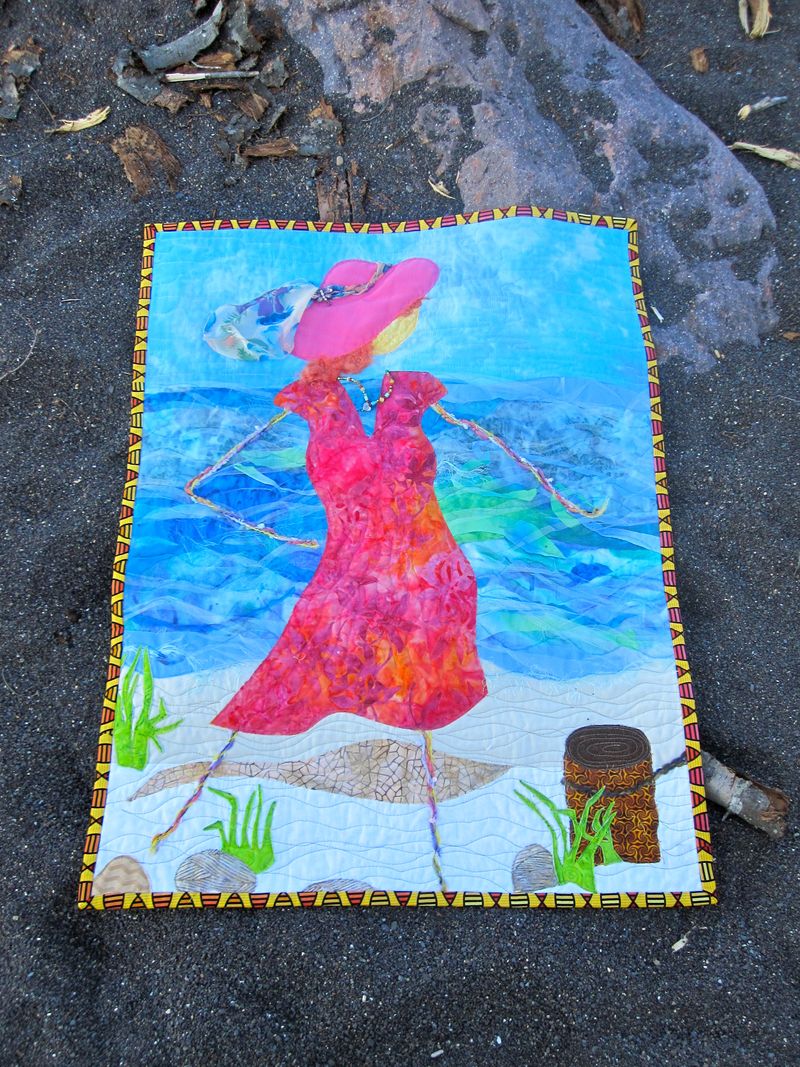
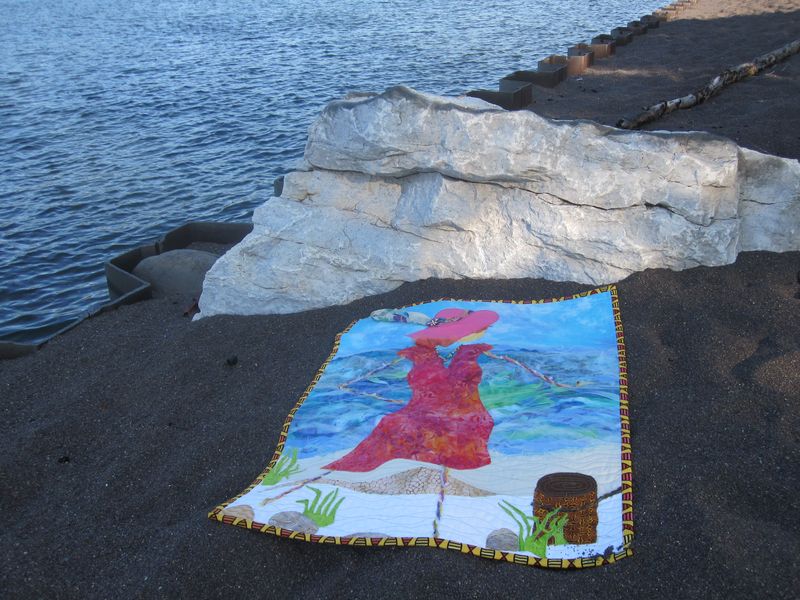
"Courage and Bravery" is the title of this quilt. It spent the winter in Ed Gray's Gallery in Calumet. When I dropped off a new bunch of quilts, I saw this and was so happy to see her again. I will hang her with the story line quilts.
The description I had written was "There is nothing more beautiful than a woman in her authenticity, a woman who has braved her own truths with courage."
My daughter Hannah took these pictures, she has an eye that matches Art. She naturally is able to know the right angle and how much of the background is needed to make my quilts shine. I am very grateful that she is willing to use her gifts with me.
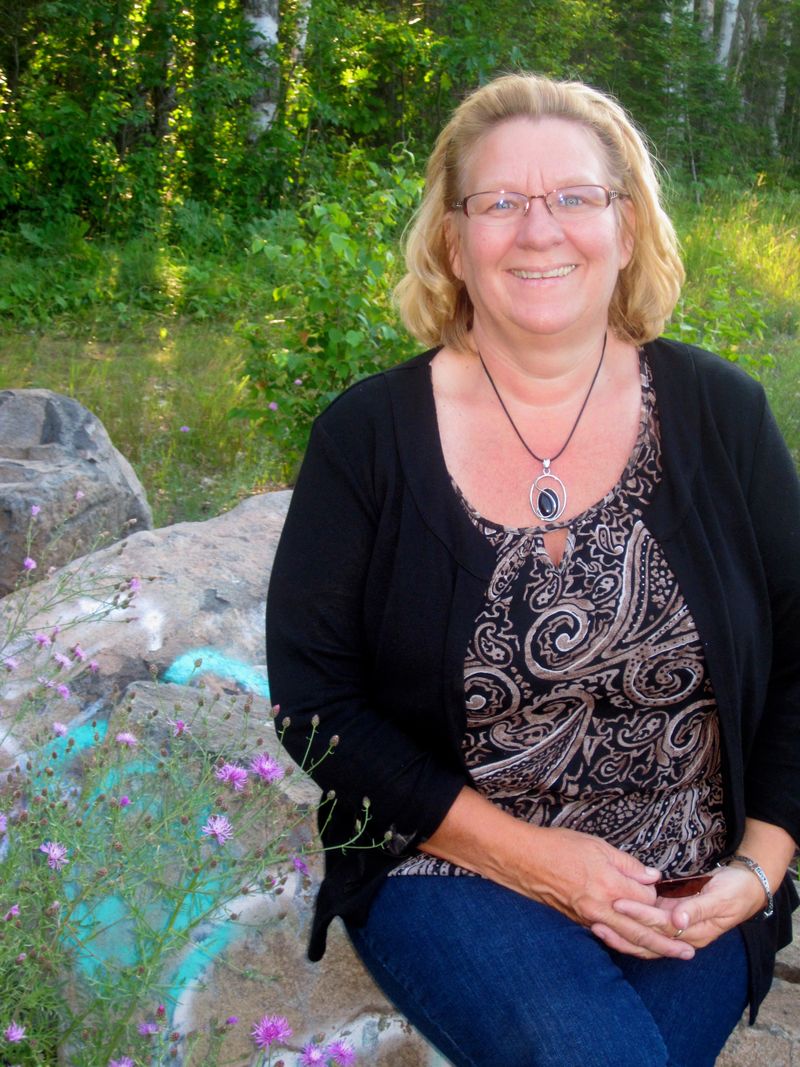
We also needed one of me for my book…so impulsively, without any artful preperations, I posed for her. Here I am in my natural best. 
It does complete my book to have a picture of the woman who created the Lady.
"On top of the abuse and neglect, denial heaps more hurt upon the child by requiring the child to alienate herself from reality and her own experience. In troubled families, abuse and neglect are permitted; it's the talking about them that is forbidden." http://adultsurvivors.blogspot.com/
Let's see if I can draw a picture as to what this is like. It is like you exist, but you can't talk about your existence, you are there but silent, moving around but not allowed to talk about it….a ghost in your own life. Where what happens in it, isn't allowed in it.
And then we wonder why children who were abused are not able to be rational, that they can't see what is going on in their lives. They have been taught to not see…to permit abuse, but to be silent about it.
That means, anything can be done to them and they will not speak up.
Silently permitting.
Here is another paragraph that struck a cord in me…
"Children don't innately know how to repress their spontaneous responses. They have to be taught, and troubled parents are perhaps the best teachers of all. There are three iron-clad rules in the abusive home: Don't talk. Don't trust. Don't feel. To break any of them means risking rejection or punishment."
Living a life that leaves out trust, feelings and talking, leaves very little to work with. It is how we are to be in our home. How can you be 'natural' if you leave out feelings and how can you relax without trust?
When I did bring in my feelings and began talking about them, I was rejected. They will say I left, and perhaps it feels better to know that. But, what I know is that no one wanted to hear how I felt…and in order to be myself, I had to go. Their rejection of my truth made it so. I could stay, but not bringing in my feelings and certainly there would be no talking about it.
Here is another great one;
"The child's sense of guilt and responsibility is useful to the abusive parent, who believes he isn't abusive..that it is the child who forces him into being abusive. The non protective adults want the child to bear the guilt so they won't have to face the harm their neglect is causing. So…the dance of the violent family begins: Children are responsible for adult's behavior…adults are responsible for nothing."
It isn't hard to imagine this, I have lived it. This is exactly how it goes. No adult is willing to be responsible. Neither sees that it is NOT the child who is causing the abuse in the home.
A violent family is one where the adults are out of control and blame the child…a child who is unable to stop, for he/she is little and has no power.
Imagine, blaming the abuse on the powerless.
Yet, this is done repeatedly until the 'powerless' one flips this around in their heads and sees where the real fault lies. It isn't a child that causes child abuse.
"Traumatic events that are human in origin seem to have more severe after-effects than natural disasters. Hurtful and frightening as it is to be raped by a stranger, or to be in the path of a natural disaster, the creation of a personal disaster by a loved one is vastly more bewildering and overwhelming." http://adultsurvivors.blogspot.com/
This paragraph from yesterdays long reading is what I have always felt, that it was worse to be abused by someone you love and trust, than it would be to violated by a stranger…for not only is your body raped, but so is your psyche.
It leaves you with no place to go to feel safe.
What I have come to learn, is that the mind took us in. The mind created a false landscape for us to rest in. However, most never leave there and return to reality.
My brother looked up the definition of Rational.
"Rational: The term rational refers to being of sound mind and having (or exercising) the ability to reason."
The ability to reason is what is lost to those of us who are abused in childhood, we use Incorrect Reasoning in order to survive, and many never learn what is correct reasoning.
The reasons we do the things we do.
My mother had her reasons for staying with my father. I would say they were incorrect based upon reality. No mother in her right mind would stay and have more children with a man who is a pedophile. Her inability to reason rationally was also taken away in her childhood.
Looking upon the family legacy and history, you could say I come from a long line of incorrect reasoning.
What I didn't know know know, is that they are seeing the pedophile, the abuse, the wounded child, BUT they are making incorrect reasons for the behavior. Mostly, blaming the child.
My father said, "The girls wanted it…"
I felt like my mother saw me as competition. I felt it. I just didn't know in what competition we were opponents in?
The biggest damage in abuse, is when we lose the ability to reason correctly.
We don't act reasonably in the face of harm etc and even act incorrectly with things that are not harmful. Our reasoning mechanism is all screwed up. We become unreasonable beings.
Some will say (family) that I have been laboring under this Abuse Issue, for way too damn long, that life is passing me by, while I am still here sorting it out. What they fail to consider is how off they are in their reasoning.
They are all making choices, but the choices are made using incorrect reasoning…and they can't tell. For all of their lives, that they can recall, this broken device has been making choices for them.
It seems preposterous that you can not know your reasoning button is broken. But, if you never had a good working one, how would you know?
What is reasonable to survive abuse is not reasonable to heal from abuse.
I had to go against all my reasoning in order to change my reasoning button.
The choices I made in the first 46 years were incorrect, they allowed me not to see abuse.
Once I saw abuse, all my 'reasonable' choices of the past, would no longer work.
The saying, "Forgive them, they know not what they do…." comes to mind.
When you see folks acting peculiar, it isn't because they don't know…it is because their reason button is broken.
Below is a post from my brother's blog. I highly recommend reading the article he found on PTSD in Adult Survivors of Child Abuse. It is a clear, but a very long piece. It helps to show why we end up the way we end up.
I have been feeling the intense effects of PTSD this past week and wanted to blog about it. I found this blog that "frames" the feelings perfectly:
http://adultsurvivors.blogspot.com/
Post Traumatic Stress In Adult Survivors Of Child Abuse
"When a victim or survivor is disbelieved, shamed, threatened into silence, or when the disclosure is minimized or becomes cause for punishment, the trauma inflicted by willful ignorance compounds the original trauma. Children can withstand a lot with the help of other people; conversely, the denial or rejection of children's normal thoughts and feelings about trauma can cause as much pain as the original trauma."
"To minimize the damage of trauma, children also need protection from further harm. But in troubled families it is not in the abuser's best interest to teach the child how to prevent further abuse. The non-protective parent who denies or minimizes the abuse is usually passive. The child is usually left on his own to figure out the best way to protect himself."
"Survivors rarely, if ever, benefited from the compassionate and reasonable reactions that would have lessened the effects of their troubled childhoods. Given the enormity of what didn't happen after their traumas, it isn't surprising that they entered adulthood numb and anxious, or both. Protective numbing and reactive anxiety are, after all, normal reactions to abnormal situations."
"Clearly, people were not meant to be physically or sexually abused. Human beings are not equipped to understand abuse as it happens, not to feel the full force of their physiological response at the time. And they cannot, at that moment, find meaning in the experience of the abuse. Each of these important elements of accommodation can only happen later, in distinct stages."
"Survivors commonly speak of how they endured trauma by pretending that their mind and spirit had gone to a safer place, leaving the body behind to endure the abuse."
"Abused children abandon reality, dissociating mind from body so they won't be overwhelmed and their ability to cope won't be shattered. Even a relatively minor trauma can provoke dissociation until a person is later able to integrate the experience. "Later", in the case of chronic abuse, particularly where the child has no support, may mean years later."
"In the short run, dissociation is a very effective defense, walling off what cannot be accommodated. Sometimes the actual memory of the abuse goes into deep freeze. An incident in the present may trigger strong feelings that really belong to an incident in the past. The survivor may become enraged by what merely annoys others, devastated when others are momentarily sad, panicked when others are just worried. Present events tap into a deep well of feelings whose source remains elusive."
"When asked what the worst memory from their childhood is, many survivors reply, "My worst memory has yet to surface."
"Sometimes only the feelings go into deep freeze. Some survivors have perfect, excruciating detailed recall of the abuse itself, but are numb to their feelings. Their hearts are in deep freeze. They do fine when they are not provoked to feel too much. They may avoid friendships and romance, or enter into them only on their own terms. They believe their feelings are as troublesome and overwhelming today as their parents once told them they were. They are numb to feelings as a way to keep control."
"Many survivors ask, "If I don't remember the trauma, or if I don't have strong feelings about it, isn't that better?" Dissociation eventually takes far more effort than it is worth. The more we try not to, the more feelings and thoughts assert themselves, unconsciously demanding our attention. It takes an enormous toll to keep perfectly legitimate memories and feelings about childhood trauma in deep freeze. In the long run, one is better letting the thaw happen, and with the support of others, participating in some manner of "cure" that will allow life to go on."
"Some survivors don't know they have a highly recognizable and treatable anxiety disorder called Post Traumatic Stress Disorder (PTSD), which has been associated with survivors of the Vietnam War, the Holocaust, mass murders, natural disasters, rape, kidnapping, accidents, torture, and other extraordinary events"
"People with PTSD often re-experience the trauma in their minds. When the memory brings on a physiological response or feeling this is called an abreaction. (The release of emotional tension through the recalling of a repressed traumatic event.) Often the situation that brings on the abreaction is reminiscent of the original trauma."
"An abreaction could be triggered by something someone says, circumstances such as the press of a crowd, being left totally alone, a darkened room…or even a particular time of the year, smells, touch, tastes…or other things associated with the trauma. Suddenly, the survivor is transported as if in a time machine to the event of the original trauma and reacts with the emotional intensity that would have been appropriate then, though not now. During an abreaction it is difficult to distinguish "what was" from "what is"."
"Herein lies the Achilles Heels for survivors. They function well in many aspects of life until they encounter the events or circumstances that are likely to trigger abreactions: emotional vulnerability, physical illness or evasive medical procedures, struggles with authority figures, cultural oppression or abandonment, to name a few."
"A person with PTSD lives with a persistent avoidance of stimuli associated with the trauma or numbing of general responsiveness. Survivors with PTSD may avoid any intimate connection, often resulting in feelings of detachment or estrangement from others. Survivors often have highly developed social skills and may seem to be extremely extroverted, but their dealings with others may preclude vulnerability. They can talk about movies or work or the weather, but they have difficulty expressing their feelings. O
r, they may have constricted feelings. They may be unable to identify and express a wide range of emotions, particularly the anger, fear and sadness so closely associated with the original traumatic events."
"Certain circumstances can make the disorder longer lasting and more severe. If a trauma is repeated, for instance, as in chronic physical or sexual abuse, then the disorder might persist more than it would after only one incident. Repitition does not make one immune to the consequences of trauma. Rather, it has a cumulative effect, as unresolved trauma is layered upon unresolved trauma."
"Traumatic events that are human in origin seem to have more severe after-effects than natural disasters. Hurtful and frightening as it is to be raped by a stranger, or to be in the path of a natural disaster, the creation of a personal disaster by a loved one is vastly more bewildering and overwhelming."
"Another circumstance that contributes to the persistence of PTSD is the victim's age. The younger the victim, the more vulnerable he is. The more developmental skills and life experiences uncontaminated by trauma a child has, the more he has to draw on in the face of trauma. When life goes well, and children are loved and protected, each day is like a deposit in a savings account. Neglect, repeated physical abuse or sexual assault…or other life-threatening events, make huge withdrawals on the account. The more a child has in the bank when the trauma occurs, the better the prognosis for a quick recovery. Small children who are repeatedly traumatized usually have few deposits and easily become emotionally bankrupt."
"When the survivor is ready to deal with it, memories and feelings begin to reconnect. He or she remembers, with the mind and feelings, instead of dismembering through dissociation."
"The beginning of reconnection is usually attributed to the fortuitous occurrence of a trigger – an event or circumstance obviously associated with or reminiscent of the original trauma. There must also always be the simultaneous occurrence of a positive trigger before the reconnection can begin. For instance, the survivor may have found someone trustworthy to talk to (therapist, friend, partner, support group) and may finally feel safe and sane enough to explore and accept her feelings."
"The pain and disorientation can be balanced by focusing on the positive trigger. During this process, survivors should ask themselves, "Why now? Why didn't I remember this two years ago? Five years ago?" The answer lies in the conjunction of this trigger, along with the negative one, which tells the survivor "you can afford to reconnect now…you have the power, judgement, insight and support that you truly did not have as a child. It is safe enough."
"Walling off parts of the trauma was once the solution to an unbearable situation. Eventually, it causes problems in the mind, heart and spirit, in ones relationships with the child within and others, and in ones work. Trauma, if left unresolved, is destined to be re-enacted in one of those vital aspects of the self."
"To recognize that a mother is exploiting you for her own ends, or that a father is unjust and tyrannical, or that neither parent ever wanted you, is intensely painful. Moreover, it is frightening. Given any loophole, most children will seek to see their parent's behavior in some more favorable light. This natural bias of children is easy to exploit."
"It is not just the child's body that is abused or neglected. Troubled families mess with a child's mind. Virtually all survivors believe that their ability to think, to intellectually master the challenges in their lives, was of of their greatest strengths as children. Like other coping mechanisms, their over-reliance on rationality fell into obsolescence and became one of their greater weaknesses."
"Children struggle to make some sense of a loved ones abusive and neglectful treatment. If the child understood what abuse really was, a random and violent imposition of another's will onto a relatively helpless person, he would despair at such hopelessness and betrayal. Therefore, he uses every mental effort to make himself seem in greater control while transforming the abusive parent into the safe and loving caretaker he so desperately needs. Such lies of the mind require mental gymnastics."
"Children don't do this thinking in a vacuum. In some situations they are told what to think. In most cases they are influenced by the abuser's faulty thinking and by the rationalization of the adults who passively enable the abuse to go on. Children hear what those powerful adults say and what they don't say."
"On top of the abuse and neglect, denial heaps more hurt upon the child by requiring the child to alienate herself from reality and her own experience. In troubled families, abuse and neglect are permitted; it's the talking about them that is forbidden."
"Minimization is a thinking error designed to protect the injured self, making one seem a little less injured. The need for it can lessen as the survivor can afford to embrace the full reality of the past. (Refraining from denial is an act of courage for survivors. They have to choose quite literally between being alienated from themselves and reality…or being alienated from family members who still deny abuse.)"
"In troubled families, the thinking around who is responsible is convoluted at best. Abusive parents externalize, blaming other people, places and things for their behavior. They compensate by controlling everyone around them. But…in their heart of hearts…they feel out of control. They must blame others because it is too painful to take responsibility for their unhappiness. Children are easy targets because they cannot challenge their parent's thinking errors. Few children can argue when facing an enraged mother. Hearing accusations often enough, children come to believe that they are responsible for their parent's troubled behavior."
"Unfortunately, children receive an internal psychological payoff when they believe the abuse is their fault…a false sense of power. The child can let the unfairness and danger of the violenc
e shatter him, or he can tell himself, "I'm not frightened or angry or sad or helpless or innocent. There is nothing wrong with this situation. This is happening to me for a good reason. This is happening to me because I deserve it, because I provoked it, because I was put here on Earth to endure such things. There is really nothing out of the ordinary about this."
"The child is doing the best he or she can do to make sense out of the abuse or neglect, by feeling guilty and responsible, thereby holding on to the illusion that he or she is in control of what is truly out of control. This illusion of power seems better than acknowledging that one has no power at all. Such pseudo logic quells feelings of hurt, rage, terror, confusion or sadness…rationalizing them into a deep freeze."
"The child's sense of guilt and responsibility is useful to the abusive parent, who believes he isn't abusive..that it is the child who forces him into being abusive. The non protective adults want the child to bear the guilt so they won't have to face the harm their neglect is causing. So…the dance of the violent family begins: Children are responsible for adult's behavior…adults are responsible for nothing."
"Faced with random, senseless abuse, a child begins to think herself as inherently unlovable."
"Believing oneself to be guilty, responsible, or in control of others hurtful behavior can be a tenacious habit. Many survivors deal with any overwhelming experience – physical illness, abandonment by a friend or spouse, academic or job demands – by "comforting" themselves with the illusion that they are in fact in control and to blame. An enormous amount of energy is sapped by this irrational guilt."
"Rarely do survivors see themselves as so powerful over the good in their own lives. Here, their parent's constant projection has left it's mark. Many survivors, convinced of their inherent worthlessness and inadequacy, look to other people, places and things for salvation. Only when they have the "perfect intimate partner, their dream house, or public recognition for their work" will they be redeemed. Of course, anything so powerful to save their lives might also destroy their lives, which brings the survivor back full circle to his original feeling of powerlessness. Responsible for all the pain in the world…he is inept at enjoying his own happiness."
"Fantasy, as a coping mechanism can also be a weakness. Too often fantasies become more real than relationships. Survivors may fantasize a lot about what other people think or feel about them."
"Trauma influences our ways of organizing in our minds what goes on out in the world. Survivors who have not fared well in life tend to think in sweeping generalities…people are either good or bad, with no gray area in between. Everything is "always" or "never", with no room for "doesn't matter much." In contrast, some survivors have thinking that is highly compartmentalized."
"Children simply do not have the cognitive development or life experience for clear thinking in the face of trauma. Their thinking errors reflect their best attempt to comprehend the incomprehensible…when the truth wasn't offered or allowed. A first step to recovery, then, is to examine, challenge, and change these old ways of thinking about trauma."
"The goal of sorting through the lies of the mind is to learn to take the abuse less personally, and thereby to feel safer. By looking back, the powerful adult mind can more objectively measure the powerlessness of the traumatized child."
"Thinking clearly may not be the entire answer, but it is an excellent and necessary beginning. Emerson wrote: "It is the oyster who mends its shell with pearls." But, unlike oysters, we are not solitary creatures. We mend one another as well as ourselves. Pearls of wisdom help us to take the next step…to heal in the company of other people, feeling the effects of the trauma while we hold onto our life rafts."
"Feelings begin in the body, not in the mind. Many survivors say, "I know what happened wasn't my fault, but I still feel somewhat unlovable and damaged. My self-worth is measured by how other people see me. My head knows that is wrong, but my heart feels differently. Thinking comes much more easily to me…it's still a big risk to feel. If I ever started to cry, I'd cry a river. If I ever felt the terror of it all, I'd disintegrate into nothingness."
"Children don't innately know how to repress their spontaneous responses. They have to be taught, and troubled parents are perhaps the best teachers of all. There are three iron-clad rules in the abusive home: Don't talk. Don't trust. Don't feel. To break any of them means risking rejection or punishment."
"One of the few predictable aspects of a violent family is the unpredictability of the parent's responses. Every time the child cries, he gets a different response. Soon he realizes that it is unsafe to cry. After a while, he keeps his feelings to himself and perhaps loathes spontaneity because it causes so much trouble."
"Young children offer their feelings to adults as gifts, as their currency of exchange in intimacy. All they can do to be close to adults is to offer their feelings. When their feelings are ignored or rejected as wrong, bad, troublesome, sick, crazy or stupid…they feel rejected. The young mind reasons "since my feelings are unacceptable, I must be unacceptable, too."
"Beyond teaching children to recognize and articulate their feelings, parents help children to contain and express feelings constructively. When children do not learn how to do this they may become overwhelmed by them, experiencing them as floods. They may come to fear or loathe their feelings."
"Adults from abusive homes can also become pain-avoidant. Survivors attempt to control the people and events around them so that they will never feel pain again."
"What is most tragic about pain-avoidant behavior is that it is a defense against something that has
already happened and cannot be undone. A survivor cannot live fully in the present until he or she has the past in perspective. Sometimes being preoccupied and defensive about the pain waiting in the future is just a distraction from addressing the real pain in the past."
"To be intimate is to risk pain. There are no guarantees. To miss years of loving to avoid the pain of loss is too high a price to pay."
"Survivors attempt to flee from feelings about having been abused, from normal reactions to an abnormal situation. Because that situation was life-threatening in the past, some survivors mistakenly believe that to experience those feelings today would also be life-threatening, would bring on an emotional breakdown, a falling apart akin to death. They do not understand that the breakdown has already happened, when their feelings were preempted by shame."
"A survivor can afford to look that "death" squarely in the face when he has people who will stand by him, as well as the insight and power he did not have as a child. When it is finally safe enough, the survivor will remember the memories and feel the feelings about the trauma. Such a "thawing out" is a second chance, an emotional reincarnation. Still…the first sensations that have been repressed or avoided all of ones life can feel like a tidal wave."
"When he is ready, the thoughts and feelings return. In response to what has been uncovered, he often feels great anger at the betrayal itself and the injustice and randomness of the violence."
"Underneath that anger is a terror and helplessness that is more difficult to experience than the anger. ("Maybe it wasn't as bad as I remember. Maybe I'm just exaggerating.") This can go on for a long time, but with the help of others, the survivor will eventually accept that the trauma was as bad as he knows it was."
"Profound sadness follows. This compassionate acceptance of "poor me" and the mourning of the losses that the trauma created eventually lead to resolution."
"When the losses engendered by trauma are fully mourned, the trauma loses its power over the survivor. Instead of the emotional breakdown they feared…survivors experience an emotional breakthrough! Completing the grieving process means divorcing the trauma from ones sense of identity and self-worth."
I could have highlighted all of it. It is good to recognize yourself, even if it is in an article about PTSD.