Category: Examples of an Imperfect woman

  • Loving Care of my Body

    I am calling my hungry child, "Lotta" and in doing so have created a space for me to see her wanting to have certain things.  In naming her, I am able to deal with her as you would a real child…and say no.

    Not only that, once I understood that the cravings I had were not wants of my body, but that of a child's program, I had more control to supersede it.  She has wants that are childish and very surface.

    In fact, knowing that I have this child-like appetite program wanting to take over my eating habits, allows me to recognize it as not being real.

    Real meaning an actual body craving.  The cravings instead are from a program that has been running very long unchallenged.

    Yesterday as food popped up, I challenged the request to eat and took the time to prepare foods as an adult would and not just grab and stuff in food as a child.

    It is very interesting to me, that one part of me wants to eat poorly and another healthy…and by giving up to the impulses, I was feeding Lotta.

    Feeding Lotta will have consequences I will have to pay attention to later…so I best pay attention the moment food is presented, by deciding who will be choosing the food that I will eat.

    I am not sure how long this will go on and if this is the key I needed to get a better handle on my eating, but it seemed to work.  I eat less when Lotta doesn't eat…I eat with awareness, not just blindly and uncaring about the consequences.  

    I now understand why the child doesn't care about the consequences, they disappear after being satiated…the child program's only purpose is to engorge itself.

    Once I knew that the child's portion is only to come in and eat whatever it wants and then disappear, leaving me with the clean up or added pounds…it is in my best interest not to let it eat.

    Starving Lotta is the way to shut down that long run program.

    She may not go easily, but I am on to her and I know what she loves and how it leaves me feeling and the consequences to my body.

    What was interesting in just that one day, is food lost its drama…excitement etc.  Instead it was a task…without the trappings of a party.  The party or exciting energy was all Lotta looking to have fun for a few moments in my life.

    I can see food taking on a grown up energy.  Its hard to imagine letting a child run your nutrition program…but that is pretty much how its been.

    It does seem insane to be taking back the food department from a child…that a child-like appetite and program has been feeding me.  And I wasn't able to wrestle it back from the child, for the child ate and disappeared.  You have to be aware prior to eating and eating…to keep the child at bay.

    I am sure this scenario arises in any situation where we revert to child-like behaviors, where our adult self fails to arrive, to be responsible.

    Perhaps this is what growing up is…to eliminate the programs we created as a child…or at least challenging them to see their consequences and how they fit into our intended future.

    In order to stop the hungry child within me, I have to fill myself up…with love and awareness, for it is my gut instinct that says, "A child that is loved and seen will seek other means to fill themselves up."

    My program began to keep me from feeling the feelings that were too big to feel, and it kept running unchecked.  I can now shut it down and by awareness and taking loving care of my body.


  • Completely whole all alone.

    In Mark Nepo's Book, "The Book of Awakening" for March 18th, 

    The Life of the Caretaker.

    "Accept this gift, so I can see myself as giving."

    "I have been learning that the life of a caretaker is as addictive as the life of an alcoholic.  Here the intoxication is the emotional relief that temporarily comes when answering a loved one's need.  Though it never lasts, in the moment of answering someone's need, we feel loved.  While much good can come from this, especially for those the caretaker attends, the care itself becomes the drink by which we briefly numb a worthlessness that won't go away unless constantly doused by another shot of self-sacrifice."

    "It all tightens until what others need is anticipated beyond what is real, and then, without any true need being voiced, an anxiety to respond builds that can only be relieved if something is offered or done. At the heart of this is the every present worry that unless doing something for another there is no possibility of being loved.  So, the needs of others stand within reach like bottles behind a bar that, try as he or she will, the caretaker cannot resist."

    "I have experienced this even in the simple issue of calling a loved one while away from home.  Even when no one expects to hear from me, I can agonize over whether to call.  Often, unable to withstand the discomfort of not registering some evidence of my love, I will end up going to great lengths to call."

    " In truth, caretaking, though seeming quite generous, is very self-serving, and its urgent self-centeredness prevents a life of genuine compassion.  In all honesty, to heal from this requires as rigorous a program of recovery as alcoholics enlist, including sponsors who will love us for who we are."

    "Within one's self, the remedy of spirit that allows for true giving resides somewhere in the faith to believe that each of us is worthy of love, just as we are."  Mark Nepo

    This is my disease.  This is where I felt my greatest hits of love and self worth, by how and to whom I gave.  I gave to get…I needed to be needed in order to feel worthy.  

    When I discovered this within me, I had to quit cold turkey…to stop giving with an agenda in hand.  I truly and completely felt the sentiments of "Accept this gift, so I can see myself as giving."

    I was unable to sustain my own self worth without a second party gushing or being grateful for what I had done.  My inner well of worthiness was nonexistent. Without doing for others, I was empty.

    It was very hard to purposefully not give.  I felt horrible and mean and uncaring.  The worse I felt, the more I knew how backwards I had giving.

    To give with the freedom of no returns was not something I had ever done.

    All my giving came with very fine print…."I give to make me feel special".

    I had to turn all my giving inward, to become a self contained container of worthiness, without using other people's needs to keep me afloat.

    My greatest sense of self was gained by giving…and my biggest hits of love came from what I did, not from who I was.

    It was horrifying to see that all or most of me was built outside of me…and the only way to find my true love of self, was to no longer give to be worthy.

    I had to become worthy by doing nothing for others…until my own well of worth was full.  

    The freedom of having your own well of worth is hard to explain…to be a self contained unit.  To have an inner source, a well spring of worthiness inside, to have it fed from the inside out…is to live a life completely different.

    One is empty…and forever seeking a new hit of worth.

    The other is full of self worth…self love and completely whole all alone.


  • Voice of the Adult.

    David Hawkins writes about dieting or taking care of the body in "Healing and Recovery".

    "When one reaches this level of handling appetite and hunger, one is no longer fixed on one particular food or another.  One could say, "If we have a steak tonight, that's fine, and if we don't , that's fine."  So it is okay either way. This means that one is free."

    "One characteristic of this attitude is freedom. Freedom from what?  There is freedom from being run by a program or conditioning, and freedom from being a victim of the cycle. There is freedom from the entrapment that made us feel bad about ourselves.  As we get detached from these sensations, we begin to feel good about ourselves.  In fact, our willingness to do that goes up to level 310, which has an even better feeling about it.  We begin to accept that this is nothing other than a phenomenon, just a set of vibrations going on within consciousness.  It does  not have to do with food or the body.  Those are all programs.  In essence, physics explains it as just a set of vibrations going on in the field of consciousness that are within our power to alter. Once we do that, we can really begin to love ourselves more than we did before."

    "There is another very interesting aspect going on in consciousness that will also be very helpful.  It is something you can observe within yourself, and something I picked up within myself and saw happening.  The cycle in the past was to be run by the hunger, appetite, satiation, and then guilt. All the good intentions I had about dieting and taking off weight suddenly flew out the window and disappeared somewhere.  After filling myself up with far more than I knew I needed, suddenly there was a feeling of self-disgust and guilt.  People with severe eating problems often experience that.  They go into the bathroom, throw all the food back up, and then go into self-hatred, blame, guilt, and even suicidal depression, which can become very severe.  What really happens in this type of situation?  I observed that when a person sits down to eat, it is only the adult within who wants to take off the weight, and it is really the 'inner child' who is always hungry."

    "In the past, Dr. Eric Berne, author of "Games People Play" and creator of Transactional Analysis, along with other people in that field talked about our 'child', and 'parent' tapes that are like three voices within us.  One is the desirous child; one is the adult who is rational, intelligent and educated; and one is the parent who tends to be punitive and moralistic.  The parent tape is the one who tells us about right and wrong.  When we sit down at the table or walk to the refrigerator, the adult within goes unconscious and the child takes over."

    "What does the child know about diet, weight, and calories?  Nothing. The consciousness of the child is, "I want, I satisfy, and I get," so we go to the refrigerator without realizing we are in a different state of consciousness, one in which the child is dominant.  So who is poking around in the refrigerator? The child is. Who is ordering a second hot fudge sundae or having a second helping of potatoes and gravy?  The child.  After we indulge the child without realizing what is going on, when the meal is over, the child leaves.  it has had its fill, and then who takes its place?  The parent does who then says, "How could you have been so stupid?  Why did you have seconds?  So did you have a piece of pie? Why did you put ice cream on top of the pie?  I mean, think of the calories.  You are really stupid and weak; you don't have any will power. You are no good; your self-worth is rotten."

    "At this point, we are subjected to the inner angry parent who is blaming us. Blaming whom?  Blaming the inner child.  Where has the adult been all this time?  It has been silenced. The adult was not there at mealtime or after mealtime.  The child and the parent have taken over the whole eating program, which is natural because that is where the eating patterns get set up in the first place. They get set up with the child, and who is sitting next to the child, but the parent?  So the child alternates with the parent in running the whole eating pattern."

    "In order to counter act this, we have to be aware that the pattern is running.  Just to be aware of it begins to change it.  Now we can make a note to ourselves, put it on the table or the refrigerator, and consciously call forth our adult and tell the child, "This is the place for an adult now because my adult is very conscious of its eating."  My adult knows about calories, diets, and healthy eating patterns.  I consciously call forth my adult to be here at this meal. I say, "The adult me is here now" and consciously reject the presence of the child.  Because the overindulgence does not happen, when the meal is finished, my adult stays there. No parent comes in to blame me for what has been done."

    "It does not take self-control or resisting anything; it just takes being aware. When we sit down, we say hello to our adult and be conscious.  Just as we sit down at the dinner table, we watch the kid come up in us.  I have watched myself do this. "Oh, look at who is there at the table.  Oh wow!  Look at the pile of mashed potato!  Look at the gravy!"  Just watch people's faces when they sit down at the table and we see who is 'up' in them.  We see the eyes pop open and watch the pupils of the eyes get very large.  If that is not a five-year-old kid, then I never saw one."

    "We may see a serious looking businessman walk into a restaurant with his briefcase.  He goes through the cafeteria line and then sits down.  Now, watch his face as he puts his napkin in front of him.  He picks up his napkin – somebody else is already there.  There is the kid all ready to have a good time!  Of course, after the man gets up to leave, now we instantly see, "Oh, I ate too much."  Now who is there?  Look at the frown as the man is berating himself as he walks out of the restaurant.  In his mind, he is counting calories. He just ate 3,850 calories for dinner, and his doctor told him he is supposed to have only 900 calories a day.  He figures he cannot eat until next Tuesday now and wonders how is he going to survive."

    "We can break out of this self-defeating pattern just by being aware. Make a little sign for the refrigerator door that says, "Adults Only."  Be conscious; be aware of who is there.  We will find that the adult enjoys the eating very much too, but just does not go crazy so easily."  David Hawkins

    What I love about how he breaks this down to there being three people that are vying for our attention or are in fact running our lives; The Child, The Parent and the Adult Self.

    At first when I read this I didn't distinguish between parent and adult, but read them as one.  But now I can see that my eating and actually my living patterns were created by a child and my parent.

    And how bringing in my adult self, I can take over the functions of my life that have been running on the program built by me as a child and my parent.

    This makes perfect sense to me.  I do eat like a child, often.  And then I do have a punitive parent come in and berate me…making me feel bad. While these two duke it out, my adult self is silent.  

    This silent adult self is the one who is missing in the places in my life where I have child like behaviors…as well as the beating myself up.  The over indulgent child, eating sweets and then the belittling parent spreading the icing on the cake of self loathing.  Or simply not being adult about my sweets.

    Whether this pattern has created a person 50 pounds overweight like I, or 300 pounds doesn't matter.  The key is the absence of a loving adult.

    This is the one pattern that I failed to see in practice.

    A loving adult.

    I have to be that which wasn't shown to me…the pattern of loving adult.

    What does a loving adult do?  How does a loving adult act?  

    Imagine having a loving adult take over your eating habits, doing yoga, etc.  I believe that I have had a loving adult take over parts of my life, but having a loving adult take over care of my body hasn't happened.

    The indulgent child eats for me and is lazy when it is time to work on my body…and then the parent screams and rants and raves as to why not.  No loving adult has come in to lead me through self care.  

    I almost have to wonder if subconsciously I am waiting for loving adult messages to come from my parent voice?  Waiting for this kind voice to take over patterns I have lived under and replace them with things I wouldn't even recognize as me.

    It is like I am either waiting for a loving parent or for my indulgent child to suddenly crave yoga and whole foods.

    Perhaps that is what we are waiting for…a healthy child to appear.

    What I know for sure is that a child can't lead this game of food and self care…for what I look like is the perfect pattern of a child in charge and what I feel like is having a nonloving parent.

    In order for this to change, I will have to keep returning my awareness to seek out my loving adult self…ignoring the child and parent pattern.

    And by asking for the voice of the adult.


  • Character called Me

    "Spiritual progress is based on acceptance as a matter of free will and choice, and thus everyone experiences only the world of their own choosing.  The universe is totally free of victims, and all eventualities are the unfolding of inner choice and decision."  David Hawkins

    "If we avoid the hypothetical positionality that people 'could' be different than they are, in actuality, people cannot really help being other than they are.  If they could be different, they would be.  Limitations define possibilities; the hypothetical does not exist; it is not a reality but an imagination.  It is irrational to condemn human behavior by comparing it with the hypothetical ideal."

    "Indignation gives way to compassion through understanding and brings into prominence the truth of the great historical statements, "They know not what they do" (Jesus Christ), or, "The only sin is that of ignorance" (Buddha).  David Hawkins

    For the past 7 years I have been reading and learning about reality and truth after living for 46 years unfamiliar with either.

    Isn't it unbelievable that we would have such a hard time with reality and when reality is all there is?  That living a hypothetical life isn't living at all…but escaping what is.

    Yesterday I listened to a radio conversation between Ed Bacon and Donald Miller, as they talked about what makes a great character…and what kind of character are you if they were to make a film about your life.

    What makes a great character?  

    If your life was a movie, would your character be entertaining and exciting. Donald Miller literally went out and created a fuller character, by living life completely different.

    The dialogue between them stuck with me…and I wondered how I too can live my life so as to be a deeper or more artful character.

    What will my character do?  What would add bits of excitement…how to expand as a person?

    If someone were making a movie about me…is there enough of a story there or is it mostly static repeats?  Perhaps I can't change other people, but I will be more aware and add new layers in the Character called Me.


  • A Free Spirit.

    What I hadn't considered is that our Conscience is created, that we don't come with a natural conscience; it is built into us. 

    I looked up the definition of Conscience and one that struck me was, " the nontechnical term for the moral faculty of the mind, corresponding roughly to the superego.

    Who knew that the conscience was in your mind.  I somehow believed the conscience was nestled up with my heart…and was the soul talking.

    Religion often references a 'guilty conscience'…and somehow we don't dissect it to find out what is guilty and why.

    As I have become more and more spiritual, I have felt much less guilt.  

    Removing my conscience has been a long process, for so much of my sense of self was caught up in it.  I acted in accordance to my conscience out of fear of reprisals. I didn't act out of love…but dodged punishment.

    The life lived by swerving punishment is not a life well lived.  It is survival and being an endless victim under the power of authority of your conscience.  You are not free.

    In order to remember how to spell Conscience.  I had to break it down to Con Science.  It is to con science, to fake it out…to rob our natural state of being.

    My experience of my conscience was to live under the rule of a mental mind…I called her my mental lady.  

    While under her rule and total manipulations, I didn't realize I was totally off base from my natural state of being…I lived in blind faith and was guided like the blind, with her leading the way…a superego.

    She would talk me through my life, telling me what I must and must not do…and what punishment awaited me if I dared go astray.

    While under the influence of a superego you pretty much are a prisoner of it…you are kept in line by fear and guilt.

    The collapse of my superego left me standing in my life aghast at how little of my life I was free in…or how little of me there was in my life.  I was pure conscience.

    Pure conscience is to live without a soul, spirit or Self…to be totally under the spell of a mental mind. 

    To me, being part of a strict religious group, like the FALC, is to join with like minds.  To construct consciences of similar values and morals.  But the contents have nothing to do with your soul…and everything to do with the mind.

    Imagine religions build consciences…and call it the way to Heaven.

    It is the perfect recipe for hell.

    Without a conscience you are in heaven…a free Spirit.


  • Being without a Conscience.

    Gary Zukav writes about the difference between Conscience and Integrity in his book, Spiritual Partnerships.  

    "Integrity and conscience both present themselves as guides through your life, however, they are distinctly different guides, and they take you to distinctly different places.  Conscience takes you where your culture, parents or peers want you to go.  It also discourages you from visiting places that have not been approved by them. When you ignore your conscience you feel guilty and remorseful, as though you have betrayed a trust or disappointed an expectation.  In fact, your collective expects certain behaviors from you, but it also does more than that. It imposes nonnegotiable demands."

    Conscience tells you when you have ignored a nonnegotiable demand or you are thinking about ignoring one, for example, "Don't lie" ( or "Thou shalt not lie," if you speak archaically).  Even thinking about ignoring such a demand (command) activates conscience.  You feel guilty at the least and terrified, a failure, and condemned to endless pain at worst.  These are the experiences of frightenend parts of your personality.  In other words, conscience and fear are the same. Conscience is the painful anticipation of painful punishment. The demands of every collective, no matter how different in content, are all starkly black-and-white, either-or, this or that. Conscience guides you to the painful fear of pain and the painful need to avoid pain. That is its function.  It insures that you conform to commands decreed by others or suffer punishments decreed by others."

    "Psychologists call this "internalizing" an authority.  You are not the authority. You are controlled by the authority.  Even if the authority is absent, even it it no longer exists (as in the case of a deceased parent), you are controlled by the authority.  If you disobey a command and you think that you will never be caught, you still live in the fear (pain) of being caught (and punished).  You punish yourself until you are punished by others.  The authority takes up residence inside of you as your "conscience", and you experience it as fear. Awareness of your conscience and awareness of your frightened parts of your personality are identical."

    "Five-sensory humans feel "out of integrity" when they violate a collective demand.  Multi-sensory humans feel "out of integrity" when they do something that they know is generated by fear instead of love.  They feel "in integrity" when they act in love, with compassion and wisdom…"  

    "You can not know in advance what integrity will require of you.  If you need to speak to keep yourself from feeling uncomfortable, to show people that you are there, or to control the conversation, and you are aware of it, integrity requires not speaking.  If speaking in a group intimidates you or you think that what you have to say is not important, and you are aware of it, integrity requires speaking.  Each interaction brings its own healing potential.  Integrity calls you to that potential.  If you ignore it you feel unsettled, on the "wrong track," or wanting to choose again.  If you answer the call you feel at ease and content with the path that you have chosen."

    "Conscience imposes itself upon you.  Integrity calls to you.  Conscience demands that you listen to frightened parts of your personality and obey them.  Integrity requires listening to loving parts of your personality and honoring them.  Conscience takes you where others want you to go.  Integrity takes you where your soul wants you to go." Gary Zukav

    What my religion called conscience or taught us about conscience were really all the collective fears of the adults or elders of the church, imposed upon us.  The sins and then punishment to hell all became embedded in us and drove our lives.  Steering by conscience to be steered by the collect authority in our upbringing.  

    I used to say "Let your conscience be your guide…."  Now, I know what I was saying was to do what the masses needed you to do. NOT to do as your soul decreed.

    I love how he breaks this down.  Integrity it seems to me is to go against the authority rules, to openly and defiantly oppose the conscience.  I know this is absolutely true.  For I had to walk in direct opposition of my conscience to be with my truth.  Freedom is to get out from underneath your inner ruler, called conscience.

    Living with integrity is the new definition of being without a conscience.  


  • Dancing with Quilting.

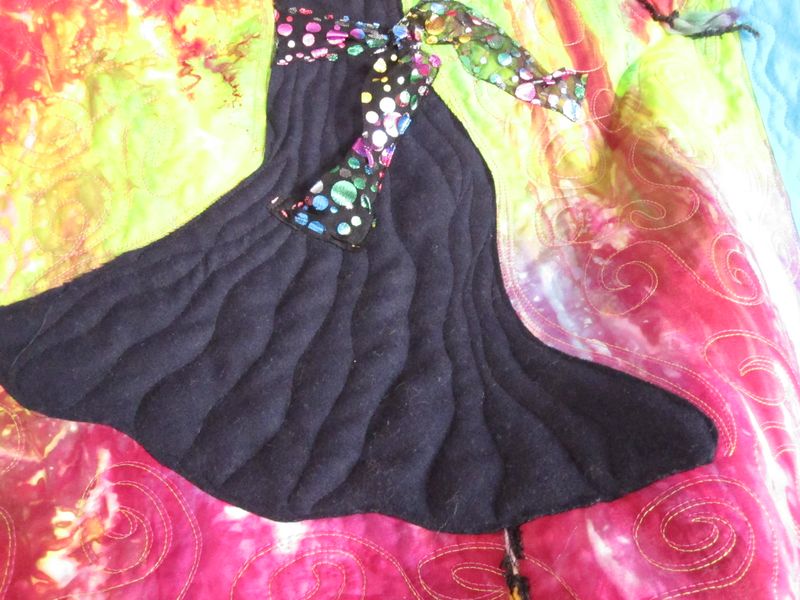
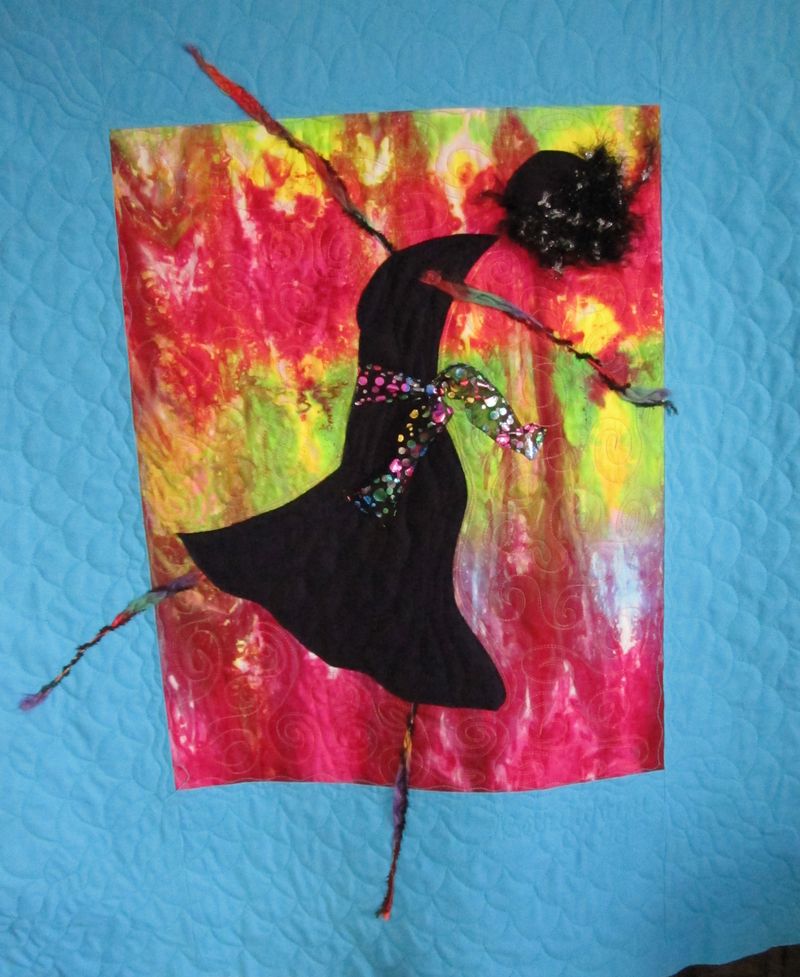
    My latest Lady Quilt.  I am trying to do dancing ladies, capturing their movement.  

    IMG_7597

    "And those who were seen dancing were thought to be insane by those who could not hear the music." ~Friedrich Wilhelm Nietzsche

    I loved this quote.  Each of us are listening to our own inner music and our movements, actions, choices, etc…are derived from what we hear inside.

    IMG_7601

    Her skirt has more movement than her arms and legs.  

    Fun to create and play with movement both in fabric, color and body.

    Dancing with quilting.


  • It is Peaceful

    Chapter 12, Spiritual Partnership.  I love this about the Diamond Scale.

    "My father owned a jewelry store in a small town in Kansas.  Somewhere in his career he acquired an antique diamond scale.  My mother kept it on a shelf of our family room bookcase.  I hardly noticed it until after he passed on.  When I did, I was impressed by its quality and elegance.  The scale itself was enclosed in a handmade glass and mahogany case.  The front panel slid up to allow access to the elegant instrument.  Its simplicity and beauty made it a work of art for me.  Two brass trays, each suspended from an arm poised on a brass column with a fulcrum at the top, balanced one another perfectly. A long needle-thin pointer, attached to the beam from which the trays hung, descended straight down the full length of the column to the base where vertical markings on a small brass plate showed its slightest deviation from center."

    "Below the enclosure was a miniature wooded drawer made with the same care. The drawer contained a small block of wood with small holes of different sizes drilled into it.  In each hole a miniature metal weight , molded into the form of a tiny cylinder with a pharmacy-style knob at the top, fit perfectly.  A delicate pair of tweezers lay beside the block, and were used to place a diamond onto one of the trays and weights onto the other, one at a time, until the needle again pointed directly downward to center. If too many weights were added to bring the trays into balance again, or too few the discrepancy was immediately evident."

    "When both trays were empty, they were level with one another. When a diamond was placed on one tray and its precise weight was placed in the other, they became level again.  Only then, at the point of perfect balance, did the long needle point vertically and precisely downward.  When either tray was above or below the other, the imbalance was obvious.  Perhaps a digital scale could weigh the diamond more precisely, but it would require calibration to insure accuracy.  My father's scale does not have this problem.  The trays are in perfect balance , full or empty, or they are not.  If they are, balance is evident.  If they are not, so it the imbalance."

    "Equality is like that.  It exists or it doesn't.  In order to see if you feel equal with another person, picture yourself on one tray of an imaginary diamond scale that is large enough to hold people, and picture another person on the other tray.  If the trays are level, you are equal. If they are not, you are unequal.  Your weight and the weight of the other person does not affect the positions of the trays as they would on a real scale.  For example, you may discover that when you put a child on the other tray, your tray surprisingly, goes up as the the child weighs more than you, or that when you put someone who is heavier than you on the other tray your tray goes down as though you weigh more."

    "That is because when you feel superior your tray is always higher than the other tray ( you look down on that person). For example, people who feel superior to their children, or to children in general, always find that their tray is higher when a child is placed on the other tray.  These people feel more worthy, important, and valuable than the child (even if they feel that they love the child).  People who feel superior in general (or entitled) live on a tray that is always higher regardless of who is on the other tray (for example, a parent or a colleague).  On the other hand, people who feel inferior (for instance, need to please) find themselves on the lower tray no matter who is on the other tray (even an abusive partner or insensitive employer).  They look up to everyone."

    "The slightest experience of superiority or inferiority upsets the balance, and one tray sinks below or rises above the other.  The scales always shows your balance (equality) or imbalance (inequality). It is your personal scale.  It does not show you the experience of others.  They have their own scales.  What they see on their scales is for them. What you see on your scale is for you."

    "I often discover that my scale is out of balance, no matter how shocked I am at each discovery. The more I explore the frightened parts of my personality, the more I see how superior some of them feel toward women, people who are older, people who are younger, and people who believe, speak or appear differently than I do.  Some of the frightened parts of my personality feel that they have no equal in creation, an extraordinarily arrogant (frightened) and inaccurate perception, but not to them.  It is a jolt to me to find that they are prejudiced in ways that I abhor, but they exist and until I became aware of them, I could not challenge them and they determined my actions."

    "As you become aware of the different parts of your personality, you may discover that your scale is out of balance as frequently as I discovered mine to be, but perhaps in different ways.  For example, you may discover a frightened part of your personality that also feels it has no equal in creation, but in the opposite way – it feels inferior to all of creation.  It does not want to take up space in the world or be seen, and it subordinates itself to everyone and everything. It cannot imagine feeling other than inferior (although, in fact, it actually feels superior to individuals who feel superior!)."

    "Inferiority and superiority are experiences of frightened parts of your personality.  Some situations activate frightened parts of your personality and feel inferior, and others stimulate frightened parts of your personality that feel superior. For example, when you put someone on a pedestal (idolize her) you feel inferior to that person, but when she fails to meet your expectations (this always happens) she falls off the pedestal (you feel superior to her).  The idol and pedestal are your creations. When you see your idol as a person like you, one illusion (you are inferior) disappears and another illusion (you are superior) replaces it.  On the other hand, if you discover that someone you did not consider important (for example a homeless person) can be very helpful to you (he is actually an eccentric billionaire), the reverse happens.  The illusion that you are superior (he does not warrant your attention) is replaced by the illusion that you are inferior (your attention is drawn to him magnetically)."

    "I was wearing work clothes while speaking with a contractor who was helping Linda and me improve our beautiful home when a subcontractor walked up and abruptly interrupted me to speak with the contractor. When the contractor introduced me as the "property owner," his behavior suddenly and dramatically changed.  He turned his full attention toward me, smiled charmingly, and extended his hand. Disregard turned into deference; one frightened part of his personality replaced another when he discovered that I was a potential employer instead of a laborer. He did not think in terms of frightened parts of the personality, but the frightened parts of his personality shaped his perception and behavior first one way and then another."

    "Sometimes when I meet someone who has something I want, or I think can help me get what I want, I find myself engaging that person more than others, being more friendly, more available, and more interested in him or her. The tray I am on goes down, and the tray the person is on goes up.  I feel inferior and I look up to him or her. The opposite also happens.  Sometimes when I meet someone I think cannot help me in any way, I find myself less interested in that person, less available, and more distant in general. The tray I am on goes up, and the tray that person is on goes down.  I look down on him or her.  I feel superior.  In this case, I usually see things about the person that I admire (judge her positively), and in the second case I often see things about the person that I don't like or approve (judge her negatively).  In both cases, I fail to see him or her as a soul."

    "These are experiences of inequality. In other words, they occur only when frightened parts of my personality are active. Frightened parts of the personality assess the external power of others and compare it with their own.  When a frightened part of our personality calculates that it has more power (ability to manipulate and control), you feel safe and valuable (superior), and your tray rises. When it calculates that it has less, you feel threatened and less valuable (inferior), and your tray sinks."

    "Feeling superior or feeling inferior is a message to you that a frightened part of your personality is active and determining your sensations, thoughts, perceptions, and intentions.  Your scale (if your picturing it) reflects this."  Gary Zukav

    What I love about this is that we each have our own inner scale and we can tell how balanced we are by how we feel inside among various people.

    I know that in the past my scales was extremely off.  I was either very superior and vastly inferior, but seldom or rarely was I ever an equal.

    It has taken me many years to balance my inner scales…and there are and will be more situations where I will have to work to find the inner balance.

    Raising my children up to a point where we are equals was huge. And even more so, raising myself up to my parents as an equal even more important.  The tricky part is not to overcompensate and then become superior, but to see them always as equals.

    "There but the grace of God go I…" comes to mind.

    To balance the scales often times I have to back up and take a full life review…and see the similarities of the journey.

    We all weigh the same…we just perceive us as different. 

    I was taught as in church, that we were special, the one and only right way, so that immediately plunge everyone else beneath me.  I was also raised to be inferior to my parents and actually all elders…and then being a victim of abuse, again lower on the scales. 

    All my beliefs were with an imbalanced scale inside of me….and it was projected as normal. I bounced high or low…but never felt on an equal ground.

    I guess a well adjusted person is one whose scale trays are always balanced, no matter what situation or person they find themselves standing with.

    I may not be completely balanced, but I do know that there is a balance and what it feels like to be there…when I am there, it is peaceful.

  • Truthful to Respond to.

    "True inner responsibility centers on our willingness to give voice to whatever is happening to us in the midst of a relationship. This is important both for you and the person you are relating to.  If you are not present, there is nothing to respond to.  And love only becomes real in the world through our ability to respond.  Bringing who you are to a relationship – being your True Self- gives other the opportunity to transcend their limitations by acting on their love.  It gives the other person a chance to show up."  Mark Nepo

    What I hadn't considered is that it takes two people to be present in a relationship, to honesty voice their feelings… 

    While I knew this instinctively, I didn't know that there was an actual formula or general rule.  When I voiced my new-found truth or honesty, it then offered to others the chance to do the same. 

    Most however, opted not to respond in-kind.  

    So, while I have carried the full ownership of many relations falling to the wayside, what I hadn't considered is that I didn't have nothing to respond to when they failed to respond back.

    "So, while we dread voicing our fears and hurts to one another, love has no way of being acted on without something truthful to respond to."  Mark Nepo

    This paragraph alone sets me free…I didn't have anything truthful to respond to.


  • Believe it is Real.

    As I look at the two different modes of relationships, friendship or a person who is looking after your soul's best interest, I can totally understand the ocean of difference it left me in.

    The typical friendship of my past, never dipped into what was good for the truthful part of me…its sole purpose was to keep me from being authentically me.  It helped me polish my exterior finish.

    It was almost like a pretend game…or perhaps was a pretend game.

    Even the interactions between my sisters and I was pretty pretend. Often we would agree to agree in person, but in truth, we were leading different lives.

    I wouldn't speak of certain things, I knew would annoy them…and they would do the same courtesy to me.  Each of us knew the invisible fence of our relationships.  The topics we would not agree on…and in order to get along, kept a wide berth of the topic.  

    I had similar relationships all over.  There was an odd dance of knowing our differences, but never speaking of them….and in doing so, "we got along". 

    We got along as long as neither of us ever wanted to be truthful.

    The authentic being or spiritual partnerships is the total opposite.

    We are not afraid to address the things that are inauthentic, we are drawn to the fence (topic) that sets us apart.  

    It isn't so much as the topic of discontent, but the way we handle it in a spiritual partnership. We go into it and search for reasons and root causes of why we think the way we think or act the way we act.  We don't hold it at arms length.

    From my experience, it is near impossible to continue on a relationship with someone who is not seeking to become authentic…while the other is.  Well, I guess you can, but you then reach a place called, social niceties.

    You become friendly….but are no longer friends, let alone spiritual partners.  You come to a place of parting…

    I totally get the difference between me and many…and it is I guess all my fault.  I changed the way I lived my life…and then it changed the way our relationship worked…it didn't work.

    For me to go back to the old mode of friendship is impossible now that I have lived authentically.  It was okay to live inauthentically while truly believing it was my truth.  But once you know your truth is falsehood, you can no longer put your faith in that which you know is not true.

    My old friendships and relationships all kept me believing or living in a false representation of my life.  The friendships got left in the place where falsehood lives.

    I don't know how to interact with them anymore…they just seem like actors in a play outside of reality.  I can't pretend to believe it is real.