I was surprised at how at ease I felt writing and even how peaceful I was inside, how comfortable I wrote my thoughts as they drifted by, as I looked upon this day, as I just seemed to write effortlessly.
Six years later the me that is doing The Artist’s Way is completely different inside than the last time…I have a hard time recollecting the old me.
She was a compilation of her parents, built upon their patterns and beliefs, structured to fulfill their needs, a woman with very little sense of self.
Now my insides are bursting with me, my knowing and fully comprehending who I am, where I came from, how I made the choices I made etc. A woman with her History pretty much figured out, but a woman with an open slate and a big world to explore.
The other thing missing inside is the fear of changing, the dread of trying something new and even appearing silly or a beginner…all my sense of pride is gone, with nothing left to lose, I can only gain.
It is astonishing to me how different I am, the years slipped by and tiny layers of confidence grew on me, so that I am in a much better spot to now add accessories to the new me.
Just as a woman adds to her outfit, I will add to the strong core of who I am, colorful and exciting things, my bling.
I have never been a person to wear wild clothes or trends, to dress with flair and be fancy, but I can feel that I am standing here, in need of a bit of that.
Perhaps The Artist’s Way will change my outward appearance to match my insides…or at least begin the reconstruction on the outside.
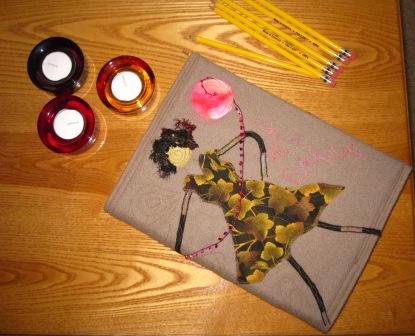
The journal cover I made for myself yesterday!
Tag: The
-
Reconstruction on the Outside.
-
My Second Childhood.
I am reading the chapter titled “Basic Tools” in The Artist Way book by Julia Cameron and love her take on both.
“Logic brain is and was our survival brain. It works on known principles. Anything unknown is perceived as wrong and possibly dangerous. Logic brain likes things to be neat little soldiers marching a straight line. Logic brain is the bran we usually listen to, especially when we are telling ourselves to be sensible.”
“Logic brain is our Censor, our second (and third and fourth) thoughts. Faced with an original sentence, phrase, paint squiggle, it says, “What the hell is that? That’s not right!”
“Artist Brain is our inventor, our child, our very own personal absent-minded professor. Artist Brain says “Hey! That is so neat!” It puts odd things together (boat equals wave and walker). It likes calling a speeding GTO a wild animal: “The black howling wolf pulled into the drive-in…”
“Artist Brain is our creative, holistic brain. It thinks in patters and shadings. It sees a fall forest and thinks: Wow! Leaf bouquet! Pretty! Gold-gilt-shimmery-earthskin-kings-carpet! Artist brain is associative and freewheeling. It makes new connections, yoking together images to invoke meaning; like the norse myths calling a boat a “wave-horse.” In Star Wars, the name skywalker is a lovely artist-brain flash.”
“Why all this logic-brain/artist-brain talk? Because the morning pages teach logic brain to stand aside and let artist brain play.”
At the end of that section on Morning Pages, she writes.
“Often, the students most resistant to morning pages come to love them the best. In fact, hating the morning pages is a very good sign. Loving them is a good sign, too, if you keep writing even when you suddenly don’t. A neutral attitude is the third position, but its really just a defensive strategy that may mask boredom.”
“Boredom is just “What’s the use?” in disguise. And “what’s the use?” is fear, and fear means you are secretly in despair. So put your fears on the page. Put anything on the page. Put three pages of it on the page.”
As for the Artist Date, the second main tool, she writes.
“The other basic tool of The Artist’s Way may strike you as a nontool, a diversion. You may see clearly how morning pages could work yet find yourself highly dubious about something called an Artist Date. I assure you, artist dates work, too.”
“Think of this combination of tools in terms of a radio receiver and transmitter. It is a two-step, two directional process out and then in. Doing your morning pages , you are sending – notifying yourself and the universe of your dreams, dissatisfactions, hopes. Doing your artist date, you are receiving, opening yourself to insight, inspiration and guidance.”
“But what exactly is an artist date? An artist date is a block of time, perhaps two hours weekly, especially set aside and committed to nurturing your creative consciousness, your inner artist. In its most primary form, the artist date is an excursion, a play date that you preplan and defend against all interlopers. You do not take anyone on this artist date but you and your inner artist a.k.a. your creative child. This means no lovers, friends, spouses, children – no taggers of any stripe.”
“If you think this sounds stupid or that you will never be able to afford the time, identifying that reaction as resistance. You cannot afford not to find time for artist dates…”
She writes later on to say. “It is frightening to spend quality time with a child or lover, and our artist can be both to us. A weekly artist date is remarkably threatening and remarkably productive.”
“A date? With my Artist?”
“Yes. Your artist needs to be taken out, pampered, and listened to. There are many ways to evade this commitment as there days of your life. “I am too broke” is the favored one, although no one said this date need involve elaborate expenses.”
“Your artist is a child. Time with a parent matters more than monies spent. A visit to a junk store, a solo trip to the beach, an old movie seen along together, a visit to an aquarium or an art gallery – these cost time, not money. Remember, it is a the time commitment that is sacred.”
“In looking for a parallel, think of a child of divorce who gets to see a beloved parent only on weekends. (During most of the week, your artist is in the custody of a stern, workaday adult.) What that child wants is attention, not expensive outings. What that child does not want is to share the precious parent with someone like a new significant other.”
“Spending time in solitude with your artist child is essential to self-nurturing. A long country walk, a solitary expedition to the beach for a sunrise or sunset, a sortie out to a strange church to hear gospel music, to an ethnic neighborhood to taste foreign sights and sounds – your artist might enjoy any of these. Or your artist might like bowling.”
“Commit yourself to a weekly artist’s date, and then watch your killjoy side try and wiggle out of it. Watch how this sacred time gets easily encroached upon. Watch how this sacred time suddenly includes a third party. Learn to guard against these invasions.”
“Above all, learn to listen to what your artist child has to say on, and about, these joint expeditions. For example, “Oh, I hate this serious stuff,” your artist may exclaim if you persist in taking it only to grown-up places that are culturally edifying and good for it.”
“Listen to that! It is telling you your art needs more playful inflow. A little fun can go a long way toward making your work feel more like play. We forget that the imagination-at-play is the heart of all good work. And increasing our capacity for good creative work is what this book is about.”
“You are likely to find yourself avoiding your artist dates. Recognize this resistance as a fear of intimacy –self-intimacy. Often in troubled relationships, we settle into an avoidance pattern with our significant others. We don’t want to hear what they are thinking because it just might hurt. So we avoid them, knowing that, once they get a chance, our significant others will probably blurt out something we do not want to hear. It is possible they will want an answer we do not have and can’t give them. It is possible we might do the same to them and that then the two of us will stare at each other in astonishment, saying, “But I never knew you felt like that!”
“It is probable that these self-disclosures, frightening though they are, will lead to the building of a real relationship, one in which the participants are free to be who they are and to become who they wish. This possibility is what makes the risks of self-disclosure and true intimacy profitable. In order to have a real relationship with our creativity, we must take the time and care to cultivate it. Our creativity will use this time to confront us, to confide in us, to bond with us, and to plan.”
“The morning pages acquaint us with what we think and what we think we need. We identify problem areas and concerns. We complain, enumerate, identify, isolate and fret. This is one step, analogous prayer. In the course of the release engendered by our artist date, step two, we begin to hear solutions. Perhaps equally important, we begin to fund the creative reserves we will draw on in fulfilling our artistry.”
Julia Cameron
Tomorrow morning is day one of week one. I am excited to begin this process. While I have been writing each morning for 6 ½ years, I will once again return to pencil and paper to see again the process of Morning Pages. As well as follow her suggestions for each week, and planning Artist Dates.
I look forward to cultivating or seeking to find new and exciting things I like to do. It has been a very long 6-½ years of healing and unraveling; I am looking forward now to actively grow Art, to intentionally play with my child self, to go hand and hand out in the big world and see what is out there.
It feels like being two or three, but in a big body, with words and able to drive myself place, to be a child without a mom holding me back, warning me or scaring me of unknown things.
My second childhood.
-
The Ten Rules For Being Human.
You Will Receive A Body
You may love it or hate it, but it will be yours for the duration of your life on Earth.You Will Be Presented With Lessons
You are enrolled in a full-time informal school called “life.” Each day in this school you will have the opportunity to learn lessons. You may like the lessons or hate them, but you have designed them as part of your curriculum.There Are No Mistakes; Only Lessons
Growth is a process of experimentation, a series of trials, errors, and occasional victories. The failed experiments are as much a part of the process as the experiments that work.Lessons Are Repeated Until Learned
Lessons will repeated to you in various forms until you have learned them. When you have learned them, you can then go on to the next lesson.Learning Does Not End.
There is no part of life that does not contain lessons. If you are alive, there are lessons to be learned.“There” Is Not Better Than “Here.”
When your “there” has become a “here”, you will simply obtain another “there” that will look better to you than your present “here.”Others Are Only Mirrors Of You.
You cannot love or hate something about another person unless it reflects something you love or hate about yourself.What You Make Of Your Life Is Up To You.
You have all the tools and resources you need. What you do with them is up to you.All The Answers Lie Inside Of You.
All you need to do is look, listen, and trust.You Will Forget All Of This At Birth
You can remember it if you want by unraveling the double helix of inner knowing.Summary
Your time here on Earth is brief. Time passes and things change. You have options and choices in which to make your wishes, dreams, and goals become reality.
When you ask yourself, ‘Why am I here?’ or ‘Why is this happening to me?’ or ‘What’s it all about?’ turn to your spiritual primer. Ask yourself, ‘What is the lesson?’ If you hear a defensive reaction using the words ‘never’ or ‘always’ in your response, you haven’t yet learned the lesson. Next, go a little deeper and ask, ‘What is there for me to learn from this experience?’
Each time you view your circumstances as possessing value, regardless of the apparent confusion or hardship, you grow. Your personal evolution will depend on how readily you embrace your lessons and integrate them into your
life. Remember, the only consequence for resisting lessons, is that they will
keep repeating themselves until you learn them. When you have learned a lesson, you will always be tested. When the lesson is learned, the test will be easily passed, and you then move on to more complex and challenging ones.You can look back on the incidents in your past and see clearly the lessons you have learned, resisted, and are still repeating. ‘Yesterday is history, tomorrow is a mystery, and today is a gift, that is why we call it the present.’
It is more challenging to look at your present situation and see exactly what your lessons are. Looking into the future is the most difficult. Wishing that you had already graduated from the school of life does not accelerate your progress or make the lessons any easier. Examining the situation for the real lesson is the scavenger hunt.
Remind yourself that you are here to learn lessons. Be present with your process. Pay attention to what you are experiencing. Be diligent with actions which enable you to ‘get’ the lessons presented to you. Ask for answers and
you shall receive them. Listen with an open heart. Explore all options. See your judgment as a mirror. View each crisis as an opportunity. Trust yourself.Believe in yourself. Look within yourself, to your higher self, for guidance on all your choices. Extend compassion to yourself. Remember, there are no mistakes, only lessons (Rule Three). Love yourself, trust your choices, and everything is possible!
From If Life is a Game, These are the Rules, © 1998 by Cherie Carter-Scott,
published in the UK in 1999 by Hodder & StoughtonSeen this on Facebook today….and love it.
-
The Artist Way.
December 1, 2004, I began writing Morning Pages, a tool in the book, “The Artist Way,” A Course in Discovering and Recovering your Creative Self, by Julia Cameron.
Here Julia explains the Morning Pages.
“There is no wrong way to do Morning Pages. These daily meanderings are not meant to be Art. Or even writing. I stress that point to reassure the nonwriters working with this book. Writing is simply one of the tools. Pages are meant to be, simply, the act of moving the hand across the page and writing whatever comes to mind. Nothing is too petty, too silly, too stupid, or too weird to be included.”
“The Morning Pages are not supposed to sound smart – although sometimes they might. Most times they won’t and nobody will ever know except you. Nobody is allowed to read your morning pages except you. And you shouldn’t even read them yourself for the first eight weeks or so. Just write three pages, and stick them into an envelope. Or write three pages in a spiral notebook and don’t leaf back through. Just write three pages and three more the next day.”
“Although occasionally colorful, the morning pages are often negative, frequently fragmented, often self-pitying, repetitive, stilted or babyish, angry or bland – even silly sounding. Good!”
“All that angry, whiny, petty stuff that you write down stands between you and your creativity. Worrying about the job, the laundry, the funny knock in the car, the weird look in your lover’s eye – this stuff eddies through your consciousness and muddies our days. Get it on the page.”
Julia CameronSix and a half years later I read my first Morning Pages, and she is absolutely correct, they are rambling, fragmented, petty and all over the board, but I recall enjoying them.
Sitting down with a notepad, a bunch of well sharpened pencils and writing three pages worth. Let me tell you, you do have to scratch and sift to find three pages worth.
It is amazing what pours out of you once you begin, “Good Morning Pages….”
I had a problem calling them pages I kept calling them papers. Nonetheless, I wrote. I wrote mindless chitchat for three days, and then it was discovered that my father was a pedophile on Dec 4th and there shows a break of about a week and a half and then I picked up a pencil and wrote again.
The Morning Pages became journals and the journals changed into a blog, but the writing continued, the exploration and discovery and recovery deepened…
This tool literally saved me as I walked into deep waters of life, however, I feel I want to go back and pick up where I left off, doing The Artist Way. Reading the book and doing the Twelve Week Exercises.
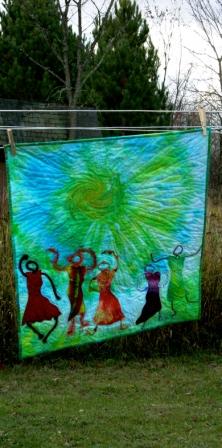
As I begin again, I have invited a bunch of Lady Friends to join me…and I am excited I do have a few takers! Anyone can join…there is room for everyone!
I am excited to begin again, as I was back then, for I felt I was idling along in life on pause or repeat perhaps and was feeling like I needed to open myself up wider…to grow or stretch, to expand my life to include more artist like things, classes or outings etc…and I feel that again.
I am once again stepping it up a level or kicking it up a notch, expanding my horizons, using this one life and experiencing more that it has to offer, adding to me some new and different things.
I will go back to handwriting the three pages each morning. I can’t wait to see what happens. I have missed the sharpened pencils and the exercise of writing without a thought…and even more excited to have Lady Friends who will join me on The Artist Way.
-
Grace and Courage
As Alice Miller’s book comes to a close, she encapsulates her thoughts.
“In this book (The Body Never Lies) I express hope that , as psychological knowledge grows, the power of the Fourth Commandment will wane in favor of the appropriate respect for the vital biological needs of the body, including truth, loyalty to oneself and to one’s perceptions, feelings and insights. If I seek genuine expressions of my feelings in a genuine form of communication, everything that was built on lies and insincerity will fall away from me. Then I will no longer strive for a relationship in which I pretend to have feelings that I do not have, or suppress others that I do have. Love that excludes honesty does not deserve the name of love.
The following points may serve to sum up these ideas.
1. The “love” of formerly abused children for their parents is not love. It is an attachment fraught with expectations, illusions, and denials, and it exacts a high price from all those involved in it.
2. The price of this attachment is paid primarily by the next generation of children, who grow up in a spirit of mendacity because their parents automatically inflict on them the thins they believe “did them good.” Young parents themselves also frequently pay for their denial with serious damage to their health because their “gratitude” stands in contradiction to the knowledge stored in their bodies.
3. The frequent failure of therapy can be explained by the fact that most therapists are themselves caught up in the snare of traditional morality and attempt to drag their clients into the same kind of captivity because it is all they know. As soon as clients start to feel and become capable of roundly condemning the deeds, say, of an incestuous father, therapists will probably be assailed by fear of punishment at the hands of their own parents if they should dare to look their own truth in the face and express it for what it is. How else can we explain the fact that forgiveness is declared to be an instrument of healing? Therapists frequently propose this to reassure themselves, just as the parents did. But because it sounds very familiar to the messages communicated to them in childhood by their parents, albeit expressed in a more friendly way, some patients may need some time to see through the pedagogic angle of it. And even once they finally have recognized it, they can hardly leave their therapist, especially if a new toxic attachment has already formed, if for them, the therapist has become like a mother who has helped them to a new birth (because in this new relationship they have started to feel). So they may continue to expect salvation from the therapist instead of listening to their body and accepting the aid it signals represent.
4. Once clients, accompanied by an enlightened witness, have lived through and understood their fear of their parents (or parental figures), they can gradually start to break off destructive attachments. The positive reaction of the body will not be long in coming: its communications will become more and more and more comprehensible; it will cease to express itself in mysterious symptoms. Then clients will realize that their therapists have deceived them (frequently involuntarily) because forgiveness actually prevents the formation of scar tissue over the old wound, not to speak of complete recovery. And it can never dispel the compulsion to repeat the same pattern over and over again. This is something we can all find out from our own experience.
“In The Body Never Lies, I have tried to show that some widely held views have long since exploded by scientific research. Among them are the convictions that forgiveness has a salutary effect, that a commandment can produce genuine love, and that feigning feelings that we do not have is compatible with the demand for honesty. But my criticism of such misleading ideas is by not means to be equated with a refusal to recognize any moral standards or with a wholesale rejection of morality.”
“On the contrary, Precisely because I staunchly uphold certain values – such as integrity, awareness, responsibility, or loyalty to oneself – I have difficulty with the denial of truths that I consider self-evident and have in fact been empirically substantiated.”
“Inability to face up to the sufferings undergone in childhood can be observed both in the form of religious obedience and in cynicism, irony, and other forms of self-alienation frequently masquerading as philosophy or literature. But ultimately the body will rebel. Even if it can be temporarily pacified with the help of drugs, nicotine, or medicine, it usually has the last word, because it is quicker to see through self-deception than the mind, particularly if the mind has been trained to function as an alienated self. We may ignore or deride the messages of the body, but its rebellion demands to be heeded because its language is the authentic expression of our true selves and of the strength of our vitality.” Alice Miller
What I find so affirming is are the major factors that Alice believes will help a person heal from abuse is what I discovered as well…
Honoring thy Mother and thy Father…is no longer valid when they don’t honor you. This is a two way road and that love without honesty isn’t love.
Secondly, the forgiveness to keep them ‘sin’ free…will not put scar tissue on our wound; it will not help heal us at all. In fact, we eventually will hurt our children, for we are still unhealed and hurt.
From what I am hearing in my old church based upon the premise of forgiveness, this is self evident. If forgiveness worked, it would have stopped a long time ago. But when you hear that the grandparent was a perpetrator, the parent was perpetrator and now a child is, Forgiveness doesn’t stop abuse!
And I love how she uses the body as a gauge for our barometer to our honesty. Your body simply does not know how to lie, it just responds in kind to the climate in which it is forced to live.
How easily our world troubles could be solved if we all were brave enough to speak our truth and walk behind it with grace and courage…
 abuse, Alice Miller, attachment, body, childhood, commandment, courage, forgiveness, fourth, legacy, lies, love, never, Religion, sexual, The, therapy
-
Elders of the Church
There are no coincidences in life and the fact that I am learning about more and more sexual abuse in my old church while I am reading Alice Miller is profound.
She is literally writing about the hows and the whys that seemingly intelligent functioning adults are unable to stop this behavior…or it seems “Knows” and does nothing.
What I am getting a view of is my family but displayed in a much bigger group, widespread from state to state.
That there is an underlying very pervasive evil preying upon the children, while half the adults sleep and the other are the perpetrators, and all presenting a mask to society of high morals and values, where TV, Music, drinking and drugs, etc are forbidden, where truth and honesty is the way of life….
The grand scale and its history from generation to generation of criminal sexual behavior under the auspices of a religion of high morals and value is mind blowing.
My mother was not an anomaly she was a typical church mother.
And what is so extremely shocking to me is that I didn’t know of it when I was in it. Yet, here is the deal on that…I didn’t leave the church until I had seen the truth of who my father was. So, I guess, their families were like my family we all matched…so we were not outstanding in the fact that the children in the family were abused.
Knowing that my father abused the neighbors and the neighbor’s parents were in the church and did nothing shows to me, that they too didn’t find this shocking or something that should be presented to the law of the land.
Again, I felt I lived in this little nest of incest with neighbors that I later found out had their own nests, but that we were the ‘odd’ ones in the church. But 6 years later, I am finding out that we are far from odd, but perhaps just normal parishioners.
In Alice’s book she speaks of forgiveness in how I seen it work in the church and how it actually is the juice that keeps the evil in the pulpits and on the church boards, literally running the church while raping the children.
“Can forgiveness for the crimes done to the child be not just ineffective but actively harmful? It certainly can because the body does not understand more precepts. It fights to make our conscious minds admit the truth and transcend our denial of genuine feelings. This is something children cannot afford to do. They have to deceive themselves and turn a blind eye to their parent’s crimes in order to survive. Adults no longer need to repress their feelings. But if they do, the price they pay is high. Either they ruin their own health or make others foot the bill.”
“A therapist who has forgiven his parents for the cruelty they showed him may feel the urge to suggest this same remedy to his clients. In so doing, he is exploiting their dependence and their trust. If he is not in touch with his own feelings at all, he may indeed be unaware that he is doing to others what was once done to him. In suggesting forgiveness as a solution, the therapist is abusing and confusing others, while rejecting any kind of responsibility for his actions. He is convinced that he is acting for their own good. Are not all religions unanimously in their conviction that forgiveness is the path to Heaven? Was not Job ultimately reward for the fact that he forgave God?”
“Unlike children, adult patients have a choice. They can leave a therapist once they have seen through his deception and self-deception….”
“To break through this vicious cycle we need to understand that so-called love cannot survive abuse, deception, and exploitation without seeking new victims. And if it requires new victims it is no longer love but at best the longing for love. Only unflinching realization of one’s own past reality, of what really happened can break through the chain of abuse. If I know and can feel what my parents did to me when I was totally defenseless, I no longer need victims to befog my awareness. I no longer need to reenact what happened to me and take it out on innocent people because now I know what happened. And if I want to live my life consciously, without exploiting others, then I must actively accept that knowledge.” Alice Miller
What is so vastly incredible is that the one thing a child needs to heal is not offered to him in that church, instead the only thing that is offered is the forgiveness of sins and the fourth commandment…”to love and Honor thy parents”.
It is no wonder to me, as a person who has lived in the system, who was abused and left untreated there, and has witnessed the responses of my siblings, that this vein of power is still in play, whether you leave the church or not, it will take Herculean power to stop the mind set of forgiving sexual crimes and not passively accept love hurts.
As long as forgiveness is preached, children will suffer abuse from the elders of the church.
-
Children will suffer.
From Alice Miller’s book “The Body Never Lies,” she writes…
“My attempts to persuade the Vatican of the importance of early childhood experiences have revealed how impossible it is to arouse feelings of compassion in men and women who right at the beginning of their lives learned to suppress their genuine, natural feelings so mercilessly that there is no trace of them left in their conscious minds. All curiosity about the feelings of others has been stifled. It seems that people who were physically mutilated in early life immure themselves in a fortress deep inside themselves, where they can only pray to God. It is to Him that they delegate all their responsibility, and they carefully obey the precepts of the church so as not to be punished by this “loving” God for any sins of omission they might commit.”
“Shortly after the capture of Saddam Hussein in late 2003, the Vatican was largely instrumental in orchestrating the sudden increase, all over the world, of voices expressing compassion for the unscrupulous tyrant who had been such an object of fear and loathing while he was still at large. But in my view we cannot simply allow ourselves to base our judgment of tyrants on ordinary compassion for the individual, if that means disregarding things they have done.”
“As biographers Judith Miller and Laurie Mylroie tell us in their 1990 book “Saddam Hussein and the Crisis in the Gulf”, Saddam Hussein was born on April 28, 1937. He grew up in a peasant family living in penury near Tikrit. They had no land of their own. His biological father died before his birth. His stepfather, a shepherd, constantly humiliated the boy, calling him “son of a whore” and “son of a bitch,” beating him mercilessly and tormenting him in the most brutal way imaginable. To exploit young Saddam’s working capacity to the full, he forbade him to go to school until the boy was ten. Instead, he would wake him in the middle of the night and tell him to guard the flocks. In these formative years, children develop and image of the world. Ideas take shape in their minds about the values that are worth upholding in life. At the same time, they begin to cherish desires and dream of their fulfillment. For Saddam, the slave of his stepfather, these desires all centered around one thing; limitless power over others. In his brain the idea presumably took shape that he could regain the human dignity he had been so radically deprived of only by possessing the same power over others that his stepfather had over him. Throughout his childhood, there were no other ideals, no other examples to live up to, only the omnipotent stepfather and himself, the defenseless victim of the terror inflicted on him. It was in line with this pattern that the adult Hussein later organized the structure of the country he ruled over. His body knew nothing but violence.”
“Every dictator denies the suffering of his childhood and attempts to forget them by indulging his megalomania. But the unconscious mind of an individual has completely registered his biography in the cells of the body, it will at some point urge that individual to confront the truth. After the coalition invasion, despite the immense financial resources at his disposal, Saddam sought refuge precisely in the vicinity of the place where he was born, the place where all help was denied him as a child, a highly precarious spot that could not provide real protection. The fact that he should have chosen this place to “go to ground” reflects the desperate plight of his early years and clearly illustrates the power of compulsive repetition. His return to his childhood was the return to the place where he had no chance to escape.”
“there is conclusive evidence that the character of a tyrant will not change as long as he lives, that he will abuse his power in a destructive way as long as he encounters no resistance. The point is that his genuine aim, the unconscious aim concealed behind all his conscious activities, remains the same: to use his power to blot out the humiliations inflicted on him in childhood and denied by him ever since. But this aim can never be achieved. The past cannot be expunged, nor can one come to terms with it, as long as one denies the suffering it involved. Accordingly, a dictator’s efforts to achieve that aim are doomed to failure. Compulsive repetition will always reassert itself. And an endless succession of victims is forced to pay the price.”
“With his own behavior, Hitler demonstrated to the world the kind of person his father was and the kind of treatment he suffered at his hands when he was a child: destructive, pitiless, ostentatious, merciless, boastful, perverted, self-enamored, shortsighted, and stupid. In his unconscious imitation he was faithful to his father’s example. For the same reason, other dictators like Stalin, Mussolini, Franco, Ceausescu, Idi Amin, Saddim Hussein behaved in a very similar way. Saddam’s biography is a striking example of how extreme humiliation in childhood is avenged on thousands and thousands of victims at a later date. The refusal to learn from these facts may be grotesque, but the reason for refusal are not difficult to identify.”
“ The fact is that an unscrupulous tyrant mobilizes the suppressed fears and anxieties of those who were beaten as children but have never been able to accuse their own fathers of doing so. Their loyalty to these fathers is unswerving, despite the torments suffered at their hands. Every tyrant symbolizes such a father, the figure whom the abused children remain attached to with every fiber of their being, hoping that one day they will be able to transform him into a loving parent by being blind.”
“This hope may have been what prompted the representation of the Roman Catholic Church to demonstrate their compassion for Hussein. In 2002, I turned to a number of cardinals for support when I presented the Vatican with material on the delayed effects of spanking and asked authorities there to do what they could to enlighten young parents on this subject. As I have said, not one of the cardinals I approached with this request showed the slightest interest in the universally ignored but crucially important issue of physically abused children. Nor did I come across the slightest indication of Christian charity or compassion in connection with this issue. Today, however, those same representatives are eager to show that they are indeed capable of compassion. Significantly, however, this compassion is lavished not on maltreated children or on Saddam’s victims but on Saddam himself, on the unscrupulous father figure that the feared despot symbolizes.”
“As a rule, beaten, tormented, and humiliated children who have never received support from a helping witness later develop a high degree of tolerance for the cruelties perpetrated by parent figures and a remarkable indifference to the sufferings borne by children exposed to inhumane treatment. The last thing they wish to be told is that they themselves once belong to the same group. Indifference is a way of preserving them from opening their eyes to reality. In this way they become advocates of evil, however convinced they may be of their own humane intentions. From an early age they were forced to suppress and ignore their true feelings. They were forced to put their trust not in those feelings but solely in the regulations imposed on them by their parents, teachers, and the church authorities. Now the task facing them in their adult lives leaves them no time to perceive their own feelings, unless those feelings happen to fit in precisely with the patriarchal value system in which they live and which prescribes compassion for the father, however destructive and dangerous he may be. The more comprehensive a tyrant’s catalogue of crimes is, the more he can count on the tolerance, provided his admires are hermetically closed off from access to the sufferings of their own childhood.” Alice Miller.
What a brilliant cycle this abuse is, for the circuitous madness not looking creates. How nature creates ways in which our mind can overrun our realities for survival and yet this very technique is what allows it to continue.
The hurt child ends up hurting children and the hurt children who don’t want to feel their pain ends up seeing the ‘heroic’ adult and not the monster.
It takes Herculean efforts to go with the body of truths and swing wide of society, church and family to see reality.
Imagine a world full of delusional adults who carry a false picture of their formative years, they will not be able to spot a monster in their presence?
No matter not how detailed his catalogue of crimes are, what matters most is that his followers, family and friends, haven’t discovered their own box of crimes of childhood…the sightless followers, the ones who love to live in the land of denial will not see his crimes.
It is incredible to me, it isn’t that they are not seeing what is going on today, but the long ago blindness that makes them unconscious supporters of evil.
You simply are incapable of seeing in the present if you didn’t see in the past.
And the sheer volume of people refusing to deal in the past wrecks havoc on today’s reality.
While I screamed loudly about the present, they clung to the vestiges of their ‘happy childhood’.
Who knew that holding tight to a ‘happy childhood’ could cause so much pain!
By not seeing who you really are you are incapable of seeing the truth in others…and this works so well for the monsters among us.
Who will stop them?
What will make the blind see, how much destruction has to be spread around the planet, before we can begin to see that children are not born this way, the parents are the cause.
As long as we don’t see the suffering children, children will suffer.
-
Survivor Self.
The Drama of the Gifted Child – The search of the true self, by Alice Miller.
Here is what she writes on the back cover of the book.
“Far too many of us had to learn as children to hide our own feelings, needs and memories skillfully in order to meet our parent’s expectations and win their “Love.” Alice Miller writes, “When I use the word “gifted” in the title, I had in mind neither children who receive high grades in school nor children talented in a special way. I simply meant all of us who have survived an abusive childhood thanks to an ability to adapt even to unspeakable cruelty by becoming numb…Without this ‘gift’ offered us by nature, we would not have survived.”
These few paragraphs explain my great power to know what others need, but really have no idea my own needs.
“In my work with people in the helping professions, I have often been confronted with a childhood history that seems significant to me.
· There was a mother who at the core was emotionally insecure and who depended for her equilibrium on her child’s behaving in a particular way. This mother was able to hide her insecurities from her child and from everyone else behind a hard authoritarian, even totalitarian façade.
· This child had an amazing ability to perceive and respond intuitively, that is, unconsciously, to this need of the mother or both parents, for him to take on the role that had unconsciously been assigned to him.
· This role secured “love” for the child – that is, his parents’ exploitation. He could sense that he was needed, and this need guaranteed him a measure of existential security.This ability is then extended and perfected. Later, these children not only become mothers (confidantes, comforters, advisors, supporters) of their own mothers but also take over at least part of the responsibility for their siblings and eventually develop a special sensitivity to unconscious signals manifesting the needs of others. No wonder they often choose to become psychotherapists later on. Who else, without this previous history, would muster sufficient interest to spend the whole day trying to discover what is happening in other people’s unconscious? But the development and perfecting of this sensitivity – which once assisted the child in surviving and now enables the adult to pursue his strange profession – also contains the roots of his emotional disturbance: As long as the therapist is not aware of his repression, it can compel him to use his patients, who depend on him, to meet his unmet needs with substitutes.” Alice Miller
I lived as a great servant for my mother’s needs for at least 40 years and never fully developed my own. This is an odd substitute for being ‘needed’ for our own self, but rather what we can offer to them.
In a section called, The Lost World of Feelings, she writes…
“ On the basis of my experience, I think that the cause of an emotional disturbance is to be found in the infant’s early adaptation. The child’s needs for respect, echoing, understanding, sympathy, and mirroring have had to be repressed, with several serious consequences.
“One such consequence is that person’s inability to experience consciously certain feelings of his own (such as jealousy, envy, anger, loneliness, helplessness, or anxiety), either in childhood or later in adulthood. This is all the more tragic that we are concerned here with lively people who are often capable of deep feelings. It is the most noticeable when they describe childhood experiences that were free of pain and fear. They could enjoy their encounters with nature, for example, without hurting the mother or making her feel insecure, reducing her power, or endangering her equilibrium. It is remarkable how these attentive, lively sensitive children, who can for example, remember exactly how they discovered sunlight in bright grass at age four, at eight were unable to ‘notice anything’ or show any curiosity about their pregnant mother or were ‘not at all’ jealous at the birth of a sibling. It is also remarkable how, at the age of two, such a child could be left alone and ‘be good’ while soldiers forced their way into the house and searched it, suffering the terrifying intrusion quietly without crying. These people have all developed the art of not experiencing feelings, for a child can experience her feelings only when there is somebody there who accepts her fully, understands her, and supports her. If that person is missing, if the child must risk losing the mother’s love or the love of her substitute in order to feel, then she will repress her emotions. She cannot even experience them secretly, “just for herself”; she will fail to experience them at all. But they will nevertheless stay in her body, in her cells, stored up as information that can be triggered by a later event.”
“Throughout their later life, these people will have to deal with situations in which these rudimentary feelings may awaken, but without the original connection ever becoming clear. The connection can be deciphered only when intense emotions have been experienced in therapy and successfully linked with their original situation.”
“Take, for example, the feelings of abandonment – not that of the adult, who feels lonely and therefore turns to alcohol or drugs, goes to the movies, visits friends or makes ‘unnecessary” telephone calls in order to bridge the gap somehow. No, I mean the original feelings in the small infant, who had not of these means to distract and whose communication, verbal or preverbal, did not reach the mother because his mother herself was deprived. For her part, she was dependent on a specific echo from the child that was essential to her, for she herself was a child in search of a person who could be available to her.”
“However paradoxical this may seem, a child is a the mother’s disposal. The mother can feel herself the center of attention, for her child’s eyes follow her everywhere. A child cannot run away from her as her own mother once did. A child can be brought up so that it becomes what she wants it to be. A child can be made to show respect; she can impose her own feelings on him, see herself mirrored in his love and admiration, and feel strong in his presence. But when he becomes too much, she can abandon that child to a stranger or to solitary confinement in another room.”
“When a woman has had to repress all these needs in relation to her own mother, they will arise from the depth of her unconscious and seek gratification through her own child, however well-educated she may be. The child feels this clearly and very soon forgoes the expression of his own distress. Later, when these feelings of being deserted begin to emerge in the therapy of the adult, they are accompanied by intense pain and despair. It is clear that these people could not have survived so much pain as children. That would have been possible only in an empathic, attentive environment, which was lacking. Thus all feelings had to be warded off. But to say that they were absent would be a denial of the empirical evidence.”
“Several mechanisms can be recognized in the defense against early feelings of abandonment. In addition to simple denial, we usually find the exhausting struggle to fulfill the old, repressed, and by now often perverted needs with the help of symbols (cults, sexual perversions, groups of all kinds, alcohol, or drugs). Intellectualization is very commonly encountered as well, since it is a defense mechanism of great power. It can have disastrous results, however, when the mind ignores the vital messages of the body. All these defense mechanisms are accompanied by repression of the original situation and emotions belonging to it.”
“Accommodation to parental needs often (but not always) leads to the “as-if personality” this person develops in such a way that he reveals only what is expected of him and fuses so completely with what he reveals that one could scarcely guess how much more there is to him behind this false self. He cannot develop and differentiate his true self, because he is unable to live it….” Alice Miller.
The last few words, ‘because he is unable to live it…is the root reason it never develops, instead the only self we know is the survivor self.
 I M Perfect lady